NFT Games: What They Promised, Why So Many Disappointed, and Why Solwaris Has None
NFT games were supposed to give players true ownership of their items. Five years after the 2021 wave, the facts are stubborn: items made useless, projects cancelled amid criticism, games shut down. Here is what an NFT game is, what went wrong, and why we chose not to make one.
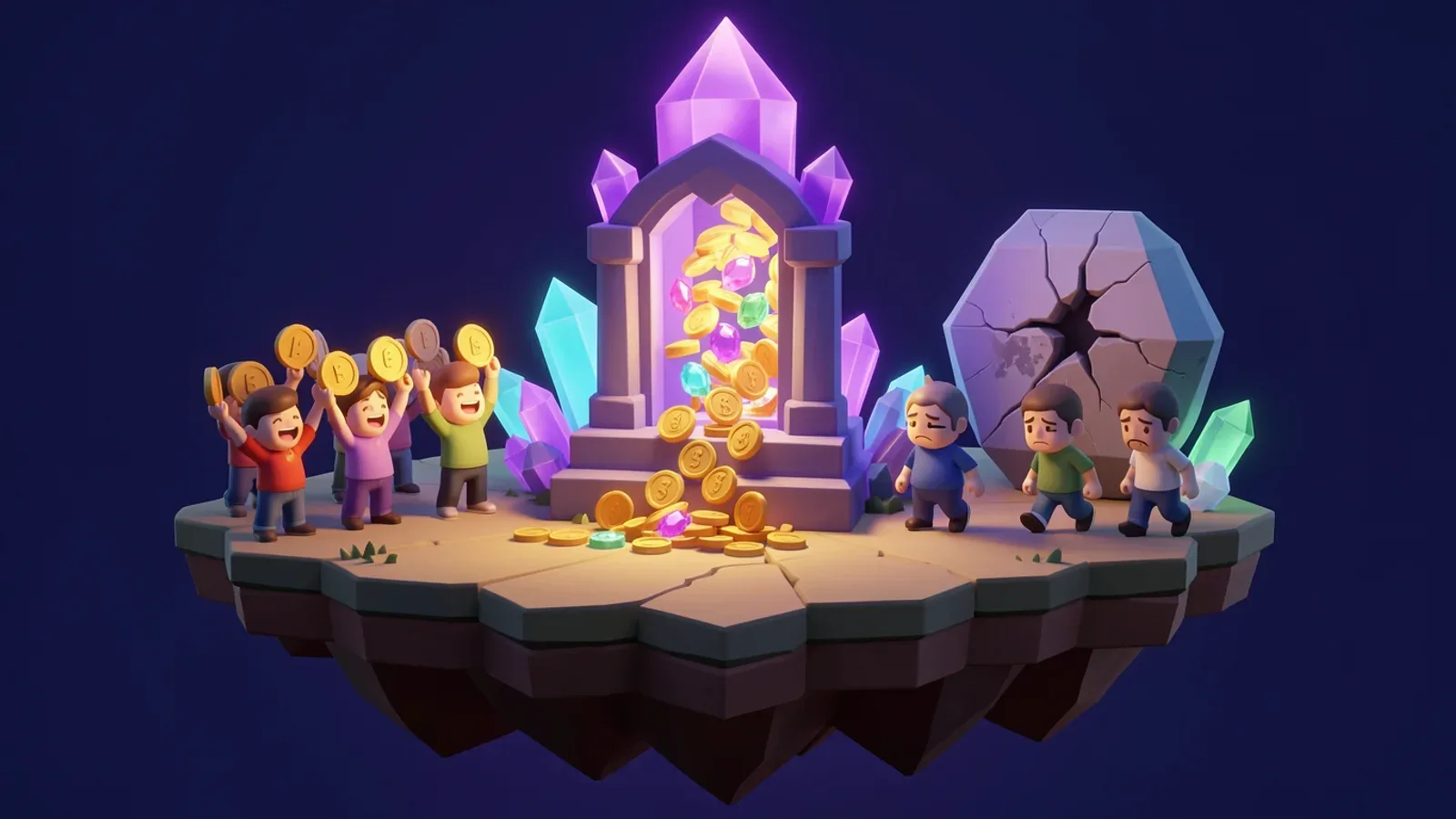
In 2021, NFT games were pitched as the future of gaming: items that truly belong to you, that you can resell, or even carry from one game to another. Today, the word mostly drives players away. That rejection is not just a matter of fashion: it rests on a series of well-documented failures. This article takes stock without dogma, with sources, then explains why Solwaris, our tactical duel game, uses no NFTs, and how its one token, the Waris, works.
What is an NFT game?
An NFT (non-fungible token) is a unique entry recorded on a blockchain, certifying that an address holds a specific digital item. In a game, that can be a character, a weapon, a card, a plot of land.
The difference from a regular game item comes down to three promises:
- Ownership: the item is yours, not the publisher’s.
- Resale: you can sell it to another player, on a marketplace, for cryptocurrency.
- Interoperability: the item might, one day, be usable in other games.
Two things that the word “NFT” often blurs need to be told apart. On one side, the ledger: a blockchain that records who holds what. On the other, the item itself: its image, its 3D model, its in-game effects. The ledger survives everything, but the item only exists in the game that knows how to display it and give it a role. An NFT sword cuts nothing outside the game that created it.
In practice, playing an NFT game also requires a crypto wallet, often buying a cryptocurrency to pay transaction fees, and constant vigilance against fake sites and booby-trapped links. For many players, that entry barrier alone is enough to put them off.
On paper, the promise is still appealing. In reality, each of these promises ran into one simple limit: a game item only has value as long as the game exists and players want it.
The promises, against the facts
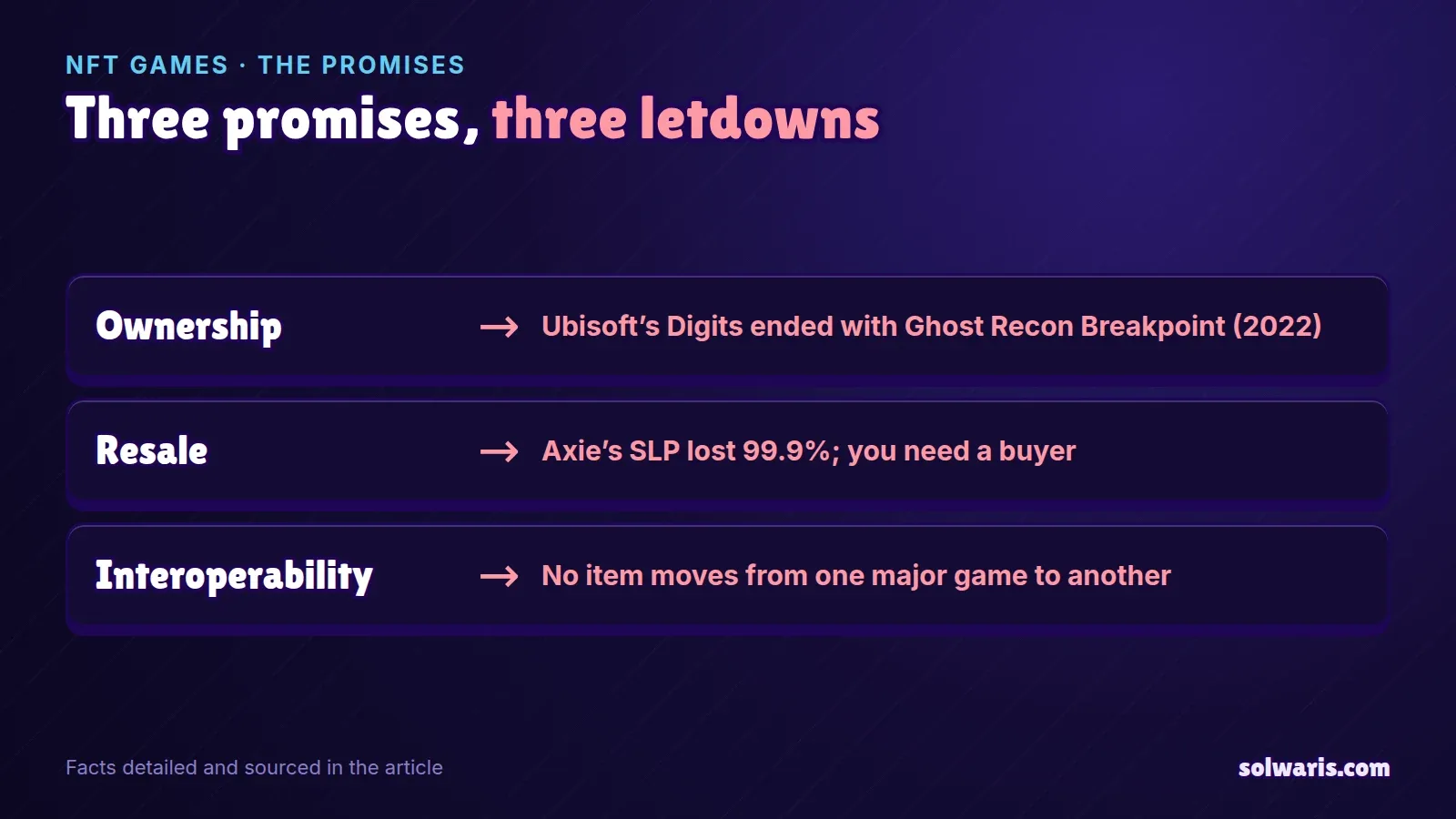
Ownership does not protect you from a shutdown. In December 2021, Ubisoft launched its Quartz platform and its “Digits”, NFTs of cosmetic items for Ghost Recon Breakpoint. The last Digit came out on 17 March 2022, and in early April 2022 Ubisoft announced the end of updates for the game. Holders kept their items, but these could not be transferred to other games.
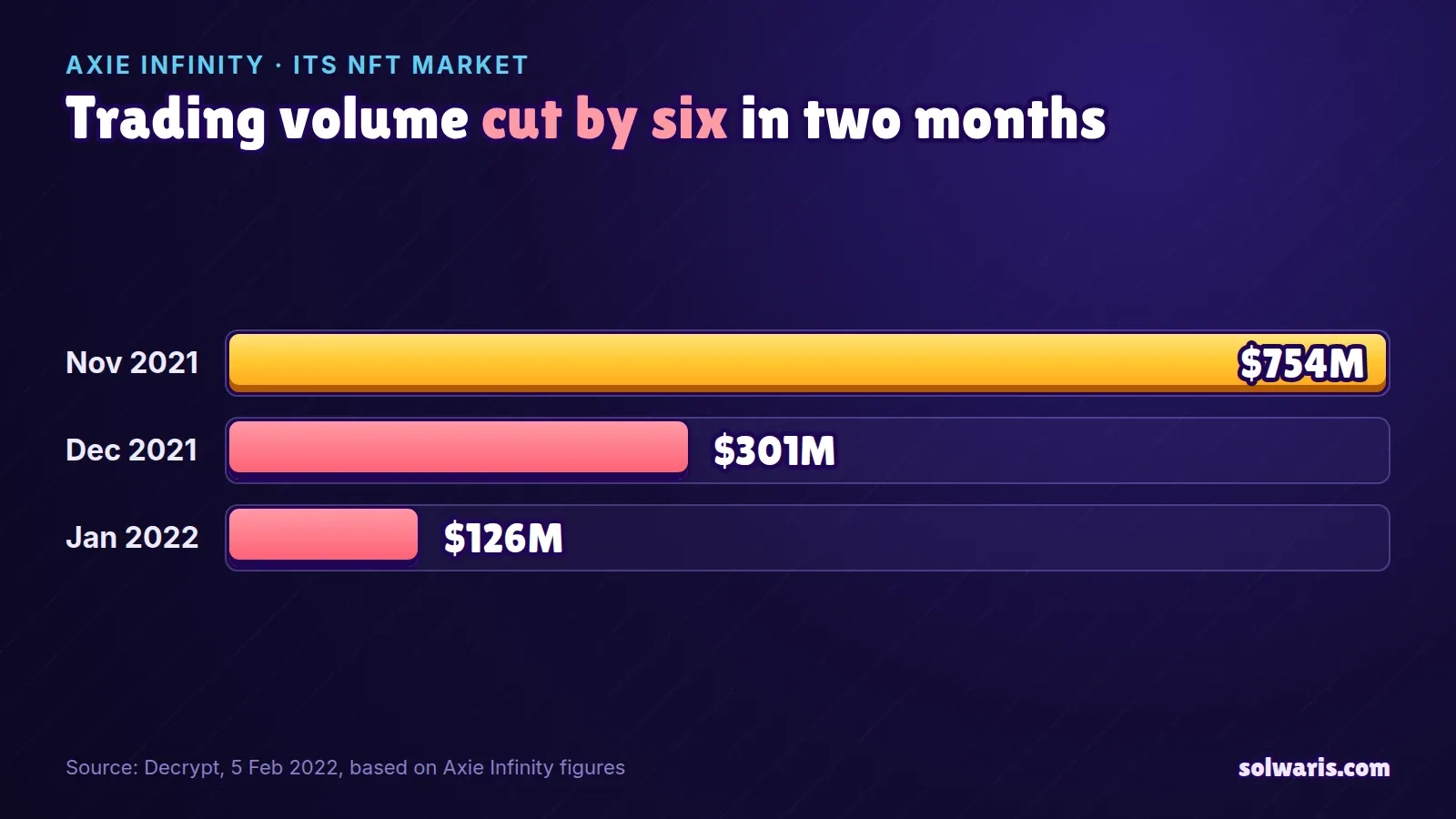
Resale depends on buyers. In Axie Infinity, the game that popularised the model, the SLP reward token peaked at $0.43 in May 2021; it had lost about 94% by February 2022, and 99.9% by the end of October 2026. Daily active players fell from a peak of 2.7 million to around 250,000 in April 2023. The NFTs followed: according to Decrypt, Axie trading volume dropped from 754 million dollars in November 2021 to 126 million in January 2022. An item or a token is only worth what another player is willing to pay.
Interoperability never really arrived. Items stay tied to the game that created them: the non-transferable Digits show it well.
Why so many NFT games disappointed
| Fact | Date | What it shows |
|---|---|---|
| Valve bans blockchain games that issue or allow the exchange of cryptocurrencies or NFTs from Steam | October 2021, rule still in force | The biggest PC store refuses these games |
| GSC Game World cancels all NFT plans for S.T.A.L.K.E.R. 2, the day after announcing them | December 2021 | Players overwhelmingly reject NFTs |
| Ubisoft stops the Ghost Recon Breakpoint Digits | March-April 2022 | An NFT item dies with its game |
| Axie Infinity’s Ronin bridge is hacked for about 625 million dollars | March 2022 | Blockchain adds security risks |
| Nyan Heroes, a Solana game, shuts down for lack of funding; its token had lost about 98% | May 2025 | Even a much-awaited game can vanish |
| Axie Infinity stops SLP rewards in its ranked mode, because of bots | January 2026 | Rewards attract automated farming |
Behind these cases, three problems keep coming back:
- Speculation comes before the game. When players come to resell, they leave as soon as prices drop.
- Money creates an advantage. As soon as a paid item improves your chances of winning, the game becomes pay-to-win, and players who do not pay leave.
- Bots and farms. A resellable reward attracts people who automate the game to extract it, to the point of forcing the publisher to cut rewards.
According to DappRadar, blockchain gaming activity kept falling in 2025, from 5.8 million daily active wallets in the first quarter to 4.66 million in the third, and at least twenty or so crypto games shut down or left the blockchain that year.
Why Solwaris does not use NFTs
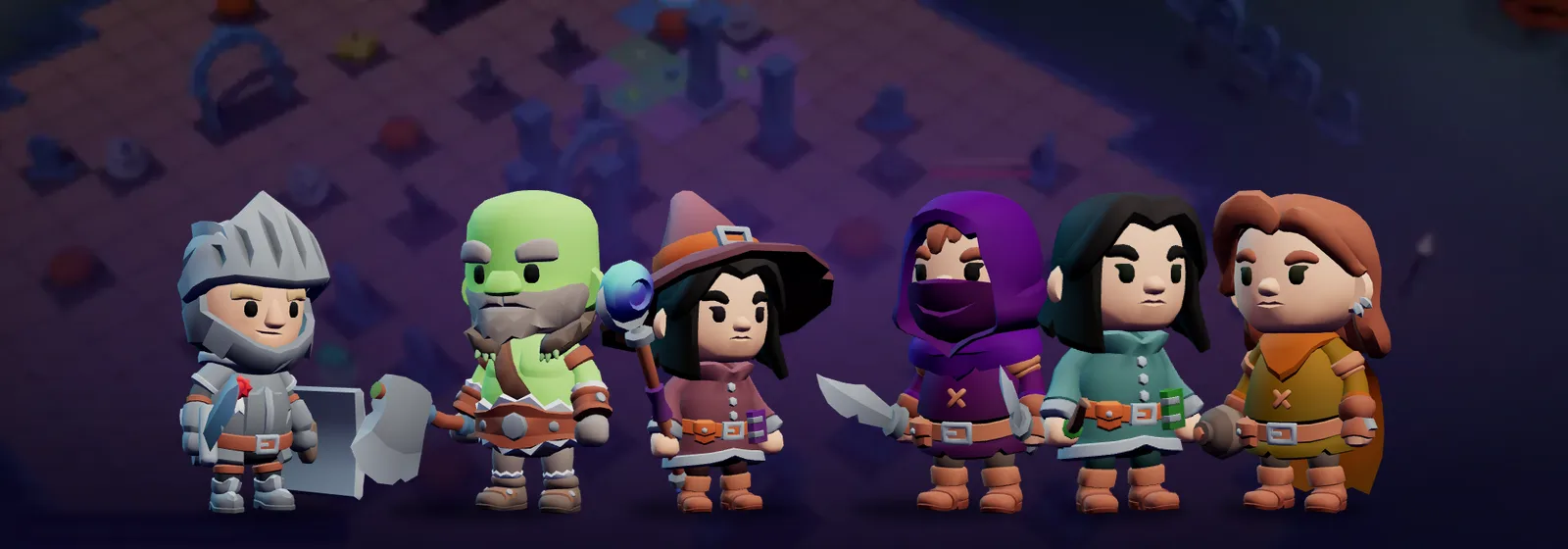
Solwaris is a turn-based 1v1 tactical duel, free in the browser. We made a simple choice: no NFTs, and one token, the Waris, earned by playing rather than bought to get in. Here is why, and what it changes in practice.
- Nothing to buy to get started. The 6 classes, ranked leagues, training against the AI and spectator mode are available without paying; a free wallet creates your account, with no transaction.
- Skins are in-game items. They are not recorded on a blockchain, cannot be resold between players, and there is no secondary market. Some are obtained with Waris earned by playing or through the Battle Pass.
- They change no rules. A skin, a weapon or an aura changes neither damage, range nor action points. Two players on the same class start with exactly the same tools.
- No hidden odds. Crystals have random contents, but every chance is published before you open one, and none gives an edge in combat.
- Nothing to speculate on. The Waris is earned by playing, never needed to start, and not tradable; nothing you own changes a fight. All that is left is the game.
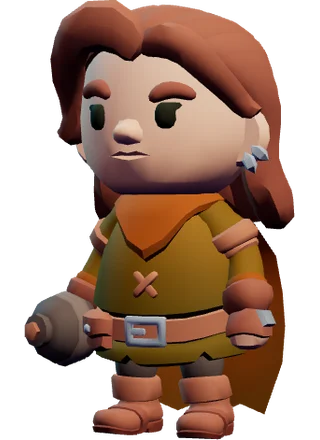 ArtificerMid-range · Area / Summon
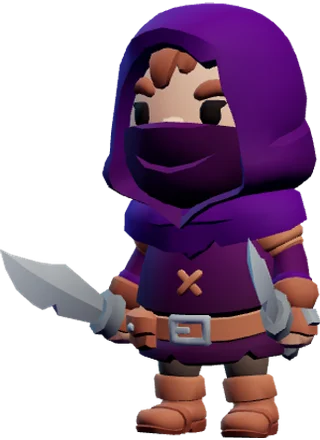 ShadeMid-range · Traps / Chance
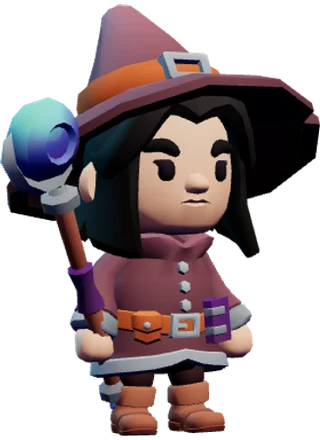 ArcanistRanged · Assault / Heal
This choice has a cost: no resellable “ownership”, no promise of earnings from playing. But that is exactly what keeps the game readable. What wins a fight is range, line of sight, positioning and the order in which you spend your 12 AP, not what you bought.
Solwaris is a young game with a small community; at off-peak hours, training against the AI lets you play while you wait for an opponent.
Before trying an NFT game: five questions
- Is the game fun without the NFTs? If not, it will not survive falling prices.
- Do you have to buy an NFT to play? A paid entry ticket is a warning sign.
- Does an NFT give an advantage in combat? If so, it is pay-to-win.
- What happens to your items if the game shuts down? Usually, not much.
- Could you lose the money without regret? If not, stick to free games.
To understand the economic model behind many of these games, also read our article What is play to earn, and is it a scam?, and our comparison of the four kinds of play-to-earn economy, with the full SLP chart.
Ghost Recon Breakpoint is a trademark of Ubisoft, S.T.A.L.K.E.R. 2 of GSC Game World, Axie Infinity of Sky Mavis; Solwaris is an independent game, not affiliated with these publishers.
A play-to-earn game where your skill pays
Pick a hero, take your position and beat another player — or an AI — turn by turn. Nothing to install: it plays right here.
Frequently asked questions
What is an NFT game?
A game in which some items, such as characters, land or cards, are recorded as NFTs on a blockchain. In principle, players can resell them outside the game on a marketplace, which gives them a price that goes up and down.
Why do NFT games have a bad reputation?
Because many relied on speculation more than on gameplay. Tokens and items lost almost all their value, projects were abandoned, and several studios dropped NFTs after strong criticism from their players, like GSC Game World with Stalker 2.
Can you play an NFT game for free?
Some offer a free mode, but earnings or full access are often reserved for those who buy NFTs. Always check what the free mode really allows before getting started.
Does Solwaris use NFTs?
No. Solwaris has no NFTs; its one token, the Waris, is earned by playing and not tradable. Its skins are in-game items that cannot be resold and change neither damage, range nor any rule.