Are Play-to-Earn Games Legit or a Scam? The Red Flags to Check Before You Connect a Wallet
Some play-to-earn games are real games run by real studios. Others were never games at all, and some honest ones collapsed anyway because their economy could only grow or die. The difference rarely shows on the trailer: it shows in where the rewards come from, who built the game, and what it asks your wallet to sign. Here is how to check all three before you connect anything.
The short answer: some play-to-earn games are legit, and a lot were not. The long answer matters more, because the games that hurt players rarely looked like scams at first. They had art, a roadmap, a Discord full of excitement and sometimes real investors. And several of the biggest failures were not scams at all: they were real games whose economy could only work as long as new players kept arriving.
So this guide starts where the money starts. It explains the four kinds of play-to-earn economy, with real price data, and shows which ones hold and which ones break. Then it goes through well-documented scams and hacks, turns them into a checklist, and ends with the part most guides skip: what your wallet is really agreeing to when you click “Sign”.
Is play to earn legit? What “legit” should mean for a game
A legit play-to-earn game is not one that makes you money. No honest game can promise that. It is one where:
- the game exists and you can play it before paying anything;
- the people behind it are identifiable and accountable;
- you can see where rewards come from: other players’ stakes, sponsors, a prize pool, or a token whose supply you can check;
- the economy does not depend on endless growth to keep paying;
- your wallet is never asked for more than the game needs.
Notice what is not on this list: token price, APY, “early access” to an NFT mint. Those are sales arguments, not proof of anything.
Where the money comes from: the four kinds of play-to-earn economy
Every play-to-earn game answers one question, whether it says so or not: when a player cashes out, whose money is it? There are only a few possible answers, and they explain most of the collapses of the last five years.
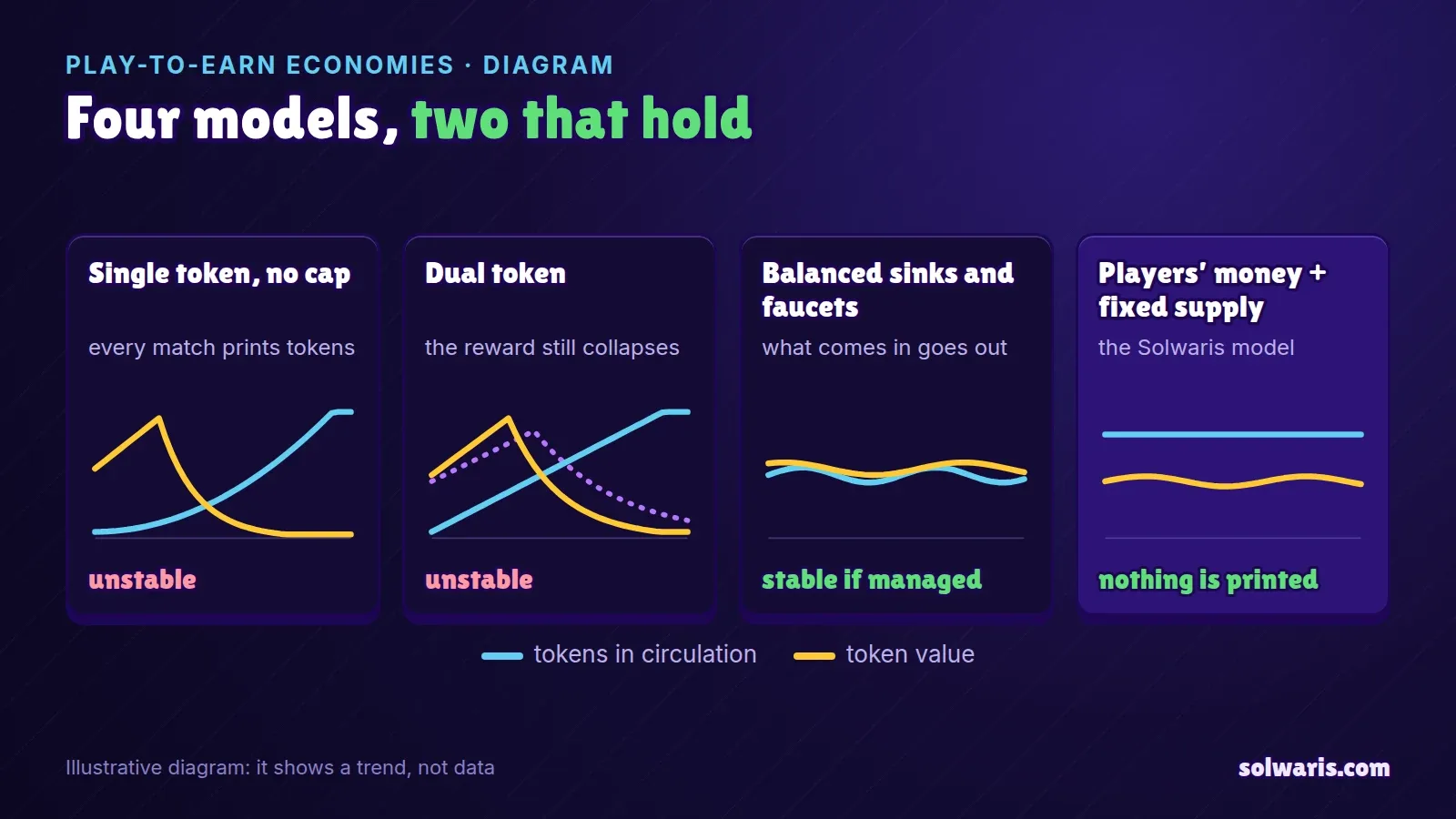
1. One reward token, no cap: the Axie Infinity and SLP spiral
The most common design of the 2021 boom was simple. You play, the game creates reward tokens and gives them to you, and you sell them on the market. In Axie Infinity, that token was Smooth Love Potion (SLP): players earned it in Adventure mode, in daily quests and in the arena, and it was destroyed (burned) mainly when they bred new Axies. Its supply had no cap.
That works while new players pour in, because they buy Axies and SLP to start. The loop looks like this:
- New players buy NFTs to enter the game.
- Every player earns freshly minted SLP every day.
- Most players sell their SLP to cash out.
- The only steady buyers are newcomers, and breeders who need SLP to make more Axies for… newcomers.
When growth slows, step 4 dries up. In February 2022, Sky Mavis admitted that roughly four times more SLP was being created each day than burned, and that without “drastic and decisive action” the game risked “total and permanent economic collapse” (as reported by Decrypt and Cointelegraph). It cut SLP rewards from Adventure mode and daily quests to zero, which removed about 56% of daily SLP issuance according to BitPinas.
It was too late to restore confidence. Axie had peaked at more than 2.7 million daily players in November 2021; it was just under 2.2 million at the end of January 2022, and around half a million by June 2022 according to AFK Gaming.
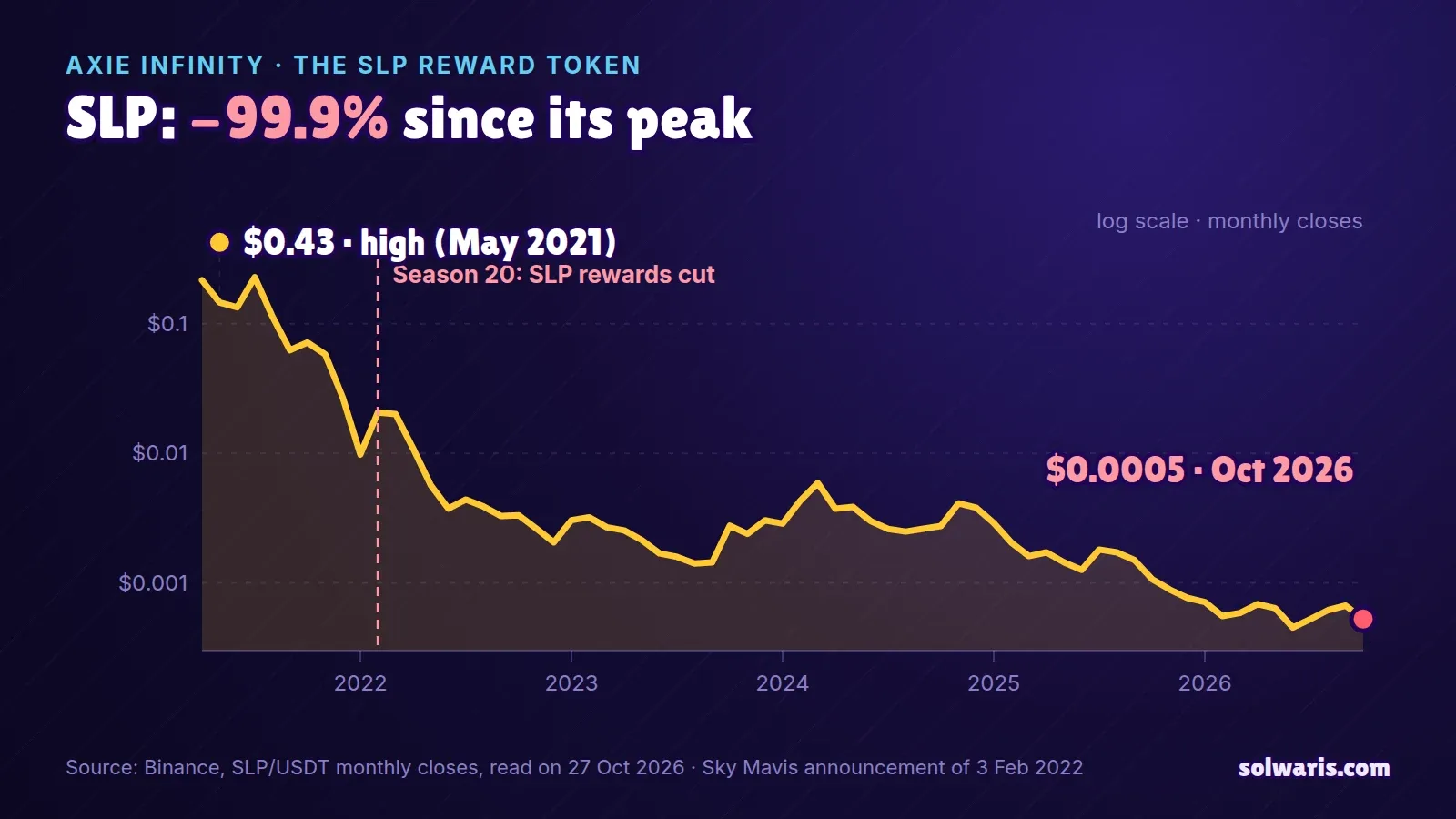
Note that this is not the story of a scam. Axie was a real game with a real studio. The design itself needed infinite growth, and nothing grows forever.
2. Two tokens: governance plus reward
The next generation tried to fix this by splitting roles. A governance token with a fixed supply (AXS for Axie, GMT for STEPN) holds the “value”; a reward token with an open supply (SLP for Axie, GST for STEPN) is what players earn and spend. The idea: inflation stays in the reward token, and the governance token is protected.
It does not work on its own. The move-to-earn app STEPN is the textbook case: its GST reward token traded between roughly $8 and $9 in late April 2022, depending on the exchange, and lost about 98% in two months, according to CryptoSlate. Its users fell by two thirds in a quarter (DappRadar, Q3 2022). And the governance tokens did not escape: when players stop arriving, nobody needs the governance token either.
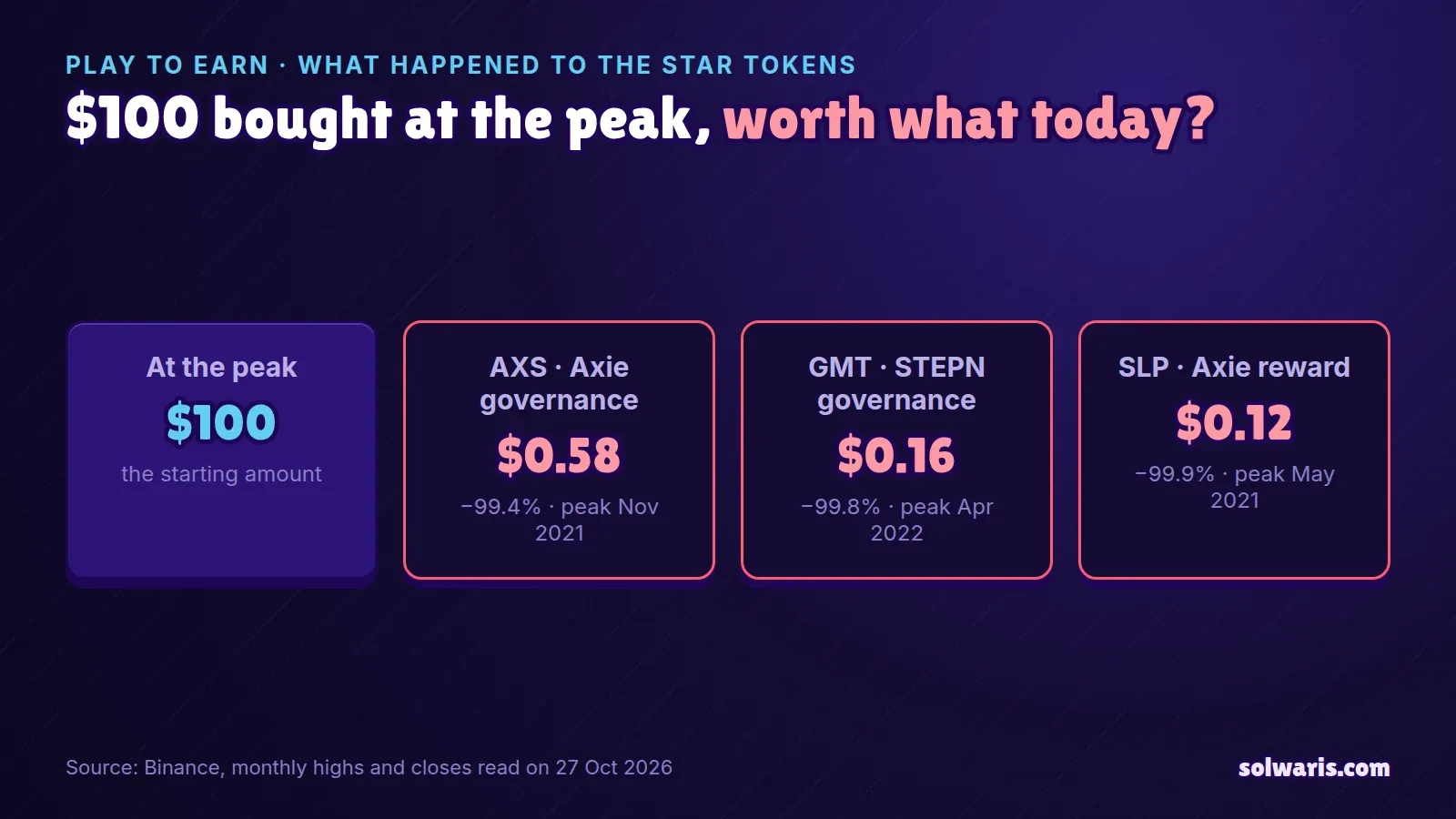
A dual-token model is a way to organise inflation, not to stop it. The question remains the same: what removes the reward token from circulation, and who buys it when growth stops?
3. Balanced faucets and sinks: the MMO approach
Long before crypto, online games had to solve the same problem. Every MMO has faucets, where currency enters the game (quest rewards, loot, bounties), and sinks, where it leaves (taxes, fees, repairs, consumables, upgrades). Think of a bathtub: if the taps run faster than the drain, it overflows and prices inflate; if the drain wins, players get poorer.
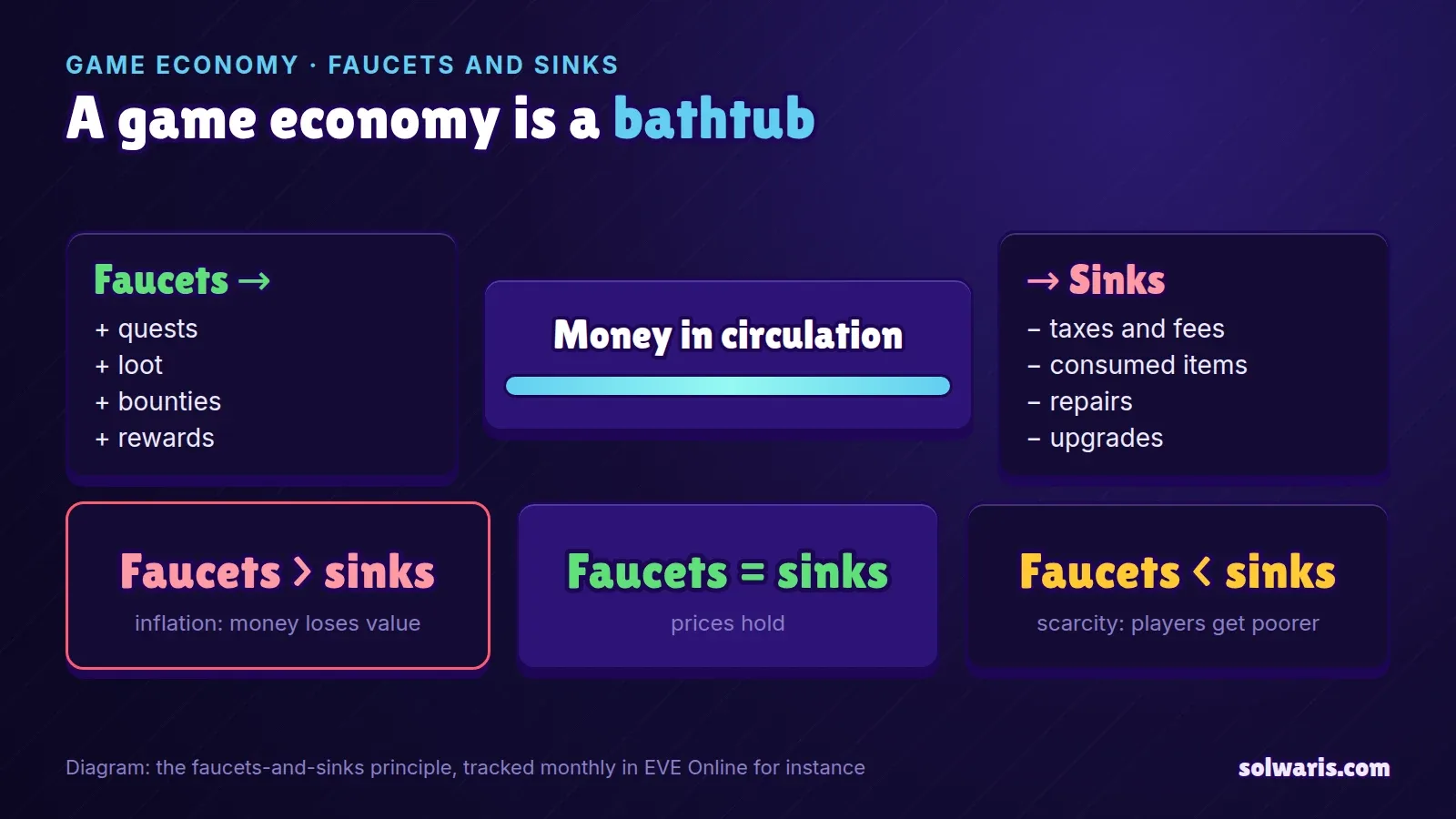
EVE Online is the reference. CCP Games has published economic reports for years, now monthly, with charts of its ISK faucets and sinks, its money supply and its price index; bounties paid for killing NPCs have long been its biggest faucet. When a faucet runs too hot, the developers change it. That is the key: this model is stable only if someone watches it and acts.
Blockchains make that harder, as the farming game Pixels found out. Its on-chain soft currency, BERRY, was inflating at about 2% a day; in February 2024 the team replaced it with off-chain Coins, converting in-game BERRY into its PIXEL token at 1,000 BERRY for 7.6175 PIXEL (BlockchainGamer.biz). Its own explanation: on-chain currencies let farmers grind harder and sell their earnings more easily.
4. Players’ money and a fixed supply: the Solwaris model
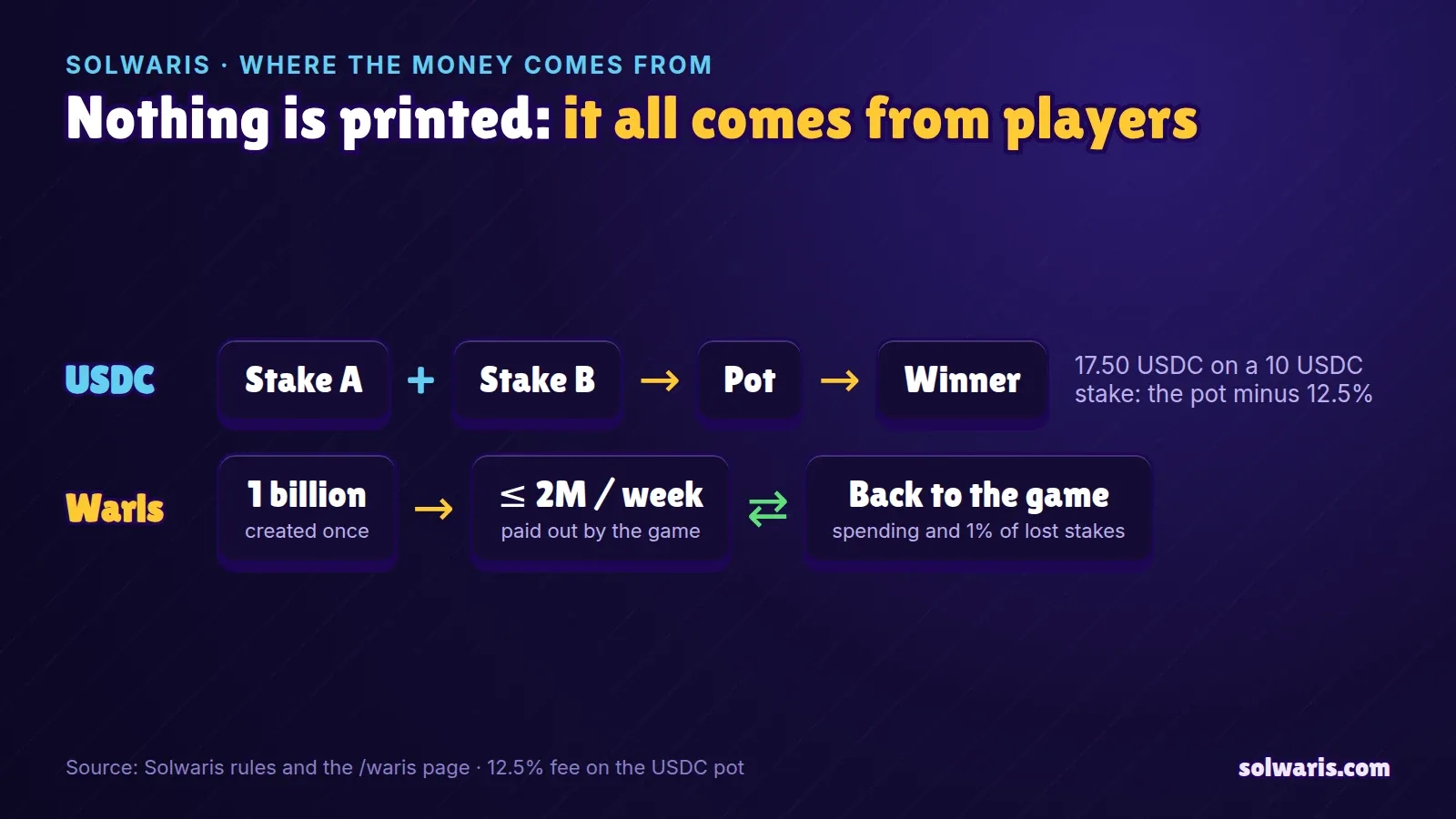
The last model removes the printing press. Rewards come from other players, not from a token created out of thin air, and whatever the game itself pays out comes from a supply that is fixed once and for all. This is how Solwaris works:
- USDC staked matches: two players stake the same amount, at 1, 5 or 10 USDC, and the winner takes the pot minus a 12.5% fee: 17.50 USDC on a 10 USDC duel. Nothing is created: every dollar a winner takes, a loser staked.
- Waris, the game’s token on Solana: 1 billion created once, with the mint authority removed, so nobody can ever add more. The game pays out at most 2 million a week, depending on activity, for levels, quests, duels and the weekly boss.
- What goes back: 1% of every lost stake, and most of the Waris spent in the shop, go back to the game and fund rewards before the reserve does. Waris the game gives away (daily gift, welcome Waris) can be played but not withdrawn, and expire after 30 days.
This design has limits too, and they are worth saying. Player-funded rewards mean every win is someone else’s loss: if you face better players, you will lose your stakes. And a fixed supply does not set a price: Waris cannot be traded yet, and nothing guarantees what it will be worth. What the model avoids is the death spiral of the first two: there is no reward token being printed faster than anyone wants to buy it. All the numbers are on the Waris page and in the economy guide.
The four models side by side
| Model | Who pays the winners | What removes tokens | How it fails | Example |
|---|---|---|---|---|
| One reward token, no cap | New players buying in | Little (breeding, crafting) | Inflation, then a death spiral when growth stops | Axie Infinity (SLP) |
| Two tokens | New players, through the reward token | Little, on the reward side | Same spiral, the governance token follows later | STEPN (GST, GMT) |
| Balanced faucets and sinks | The game, within limits | Taxes, fees, repairs, upgrades | Bad tuning, or farmers selling faster than sinks absorb | EVE Online, Pixels after 2024 |
| Solwaris: players’ money and fixed supply | Other players (stakes), a capped weekly budget | Stake fees and spending recycled into rewards | Losing your stakes to better players | Solwaris |
Four real cases, four different ways it went wrong
A sound economy is not enough: hacks and outright scams hurt players too. These cases are well documented, and each teaches a different lesson.
| Case | Year | What happened | The lesson |
|---|---|---|---|
| Ronin bridge (Axie Infinity) | 2022 | Attackers took 5 of the 9 validator keys and drained 173,600 ETH and 25.5M USDC | A real, popular game can still lose funds through its infrastructure |
| Squid Game token (SQUID) | 2021 | Selling was restricted; the token crashed 99.99% in a day when the developers left | Check that you can exit before you enter |
| Evolved Apes | 2021 | NFTs sold for a fighting game that never existed; the anonymous creator left with 798 ETH | No game, no proof |
| Nyan Heroes | 2025 | A real Solana shooter shut down for lack of funding; its token had lost about 99% | Even honest projects can close |
Ronin: the legit game that still lost the money. In March 2022, the bridge that moved funds in and out of Axie Infinity’s Ronin chain was drained. According to Elliptic, the attackers controlled five of the nine validator keys, enough to approve withdrawals, and the theft went unnoticed for six days, until a user could not withdraw 5,000 ETH. Reporting by The Block traced the entry point to a fake job offer sent as a PDF to a Sky Mavis engineer, and the FBI attributed the theft to North Korea’s Lazarus Group. The lesson is not “Axie was a scam”: it was not. It is that your funds are only as safe as the weakest system they pass through.
Squid Game token: the trap in the contract. In late 2021 a token riding on the Netflix show rose by more than 35,000% in three days. CoinDesk reported that trading rules built into the project made selling hard for holders, and the token lost 99.99% of its value in 24 hours when the developers said they were leaving. The price chart looked great. The contract was the problem.
Evolved Apes: the game that was only a promise. In 2021, a collection of 10,000 NFTs was sold as the entry ticket to a fighting game in the vein of Axie Infinity. A week after launch, the anonymous creator disappeared with 798 ETH, about $2.7 million at the time. The game never existed. In June 2024, US prosecutors charged three people with wire fraud and money laundering over the scheme.
Nyan Heroes: the honest shutdown. Not every failure is a scam. Nyan Heroes, a playable shooter on Solana, announced its closure in May 2025 because it could not secure funding. Its token had lost about 99% from its peak. Dozens of other crypto games closed or left web3 in 2025. If your money sits in a game’s token or NFTs, the studio’s runway is your risk too.
The red-flag checklist
One flag alone is not proof. An early-stage game can have an anonymous founder and still be sincere. But three or four together is the pattern the cases above have in common.
How to verify a game before connecting a wallet
Spend fifteen minutes on this. It is less than the time most people spend picking a skin.
- Play the free version first. If there is none, ask why. A game confident in its gameplay lets you try it.
- Find the company. A registered company, named founders, a studio history, press coverage that is not paid content. Search the founders’ names with “scam” and “lawsuit”.
- Read where the money comes from. Place the game in one of the four models above. If rewards are minted, how much per day, and what removes tokens from circulation?
- Check the contract and the token. Is the contract verified on the block explorer? Who holds the supply? Can the mint authority still create tokens? Can holders sell? A tiny test sale before buying more tells you more than any whitepaper.
- Look at the exits, not only the entries. How do you withdraw? What happens to your funds if a match is interrupted, or if the studio shuts down?
- Get the official URL from two sources (the official X account and the official Discord, for instance) and bookmark it. Fake sites copy real ones pixel for pixel.
What your wallet is actually signing
Connecting a wallet only shares your public address. The danger is in what you sign next. Three kinds of permission deserve your attention.
- Token approvals (Ethereum and EVM chains). An approval lets a contract spend your tokens on your behalf. As Revoke.cash explains, a contract holding that permission can use it at any time, not only during the action you had in mind. Many sites request an unlimited amount by default.
- setApprovalForAll (NFTs). One signature gives a contract the right to move every NFT you hold in a collection, not just one.
- Delegations (Solana). On Solana, the token program lets you approve a delegate to move a capped amount from a token account. According to the Solana documentation, a token account has one delegate at a time, and the owner can revoke it with a single instruction.
Attackers know this. Scam Sniffer counted $83.85 million stolen by signature phishing in 2025, from 106,106 victims, down from $494 million in 2024. The largest cases relied on permit-style signatures that looked harmless on screen.
Where Solwaris fits
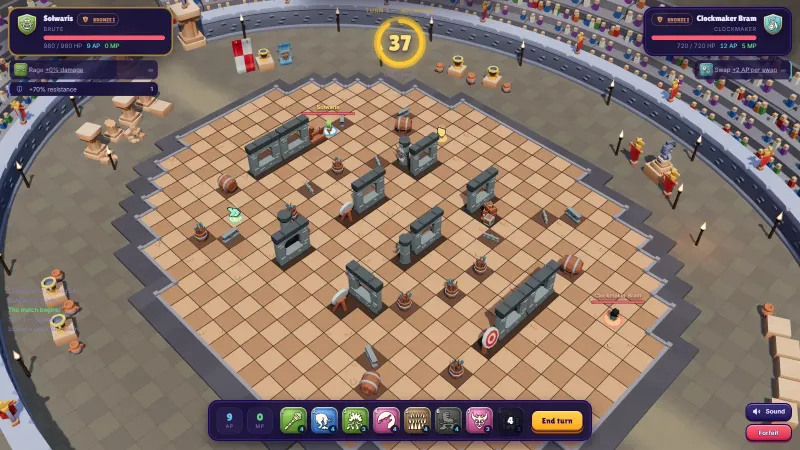
Solwaris is a 1v1 turn-based tactics game played in the browser. We will not tell you to trust it because we say so. Here is how it measures against the checklist above, with its limits.
- Free to play, with a free wallet. The whole game, all 6 classes, the ranked leagues and the AI training are free; your wallet creates your account with one signature and no transaction.
- Where the money comes from. Model 4 above: USDC stakes between players, and Waris from a fixed supply of 1 billion with no mint authority. There is no NFT, and no item changes the rules: two players of the same class have the same spells.
- What you sign. For USDC matches, a capped SPL delegation on Solana, sized to the stake, that you can revoke at any time. Both stakes move to an address dedicated to that single match.
- Its limits. Stakes can be lost, and often will be if you face a better player. Solwaris is a young game with a small community: at quiet hours you may wait for an opponent.
The bottom line
Are play-to-earn games legit? Some are, and you can tell them apart if you look at the right things. First the economy: who pays the winners, and what happens when growth stops. Then the people: a game you can play first and a team you can name. Then your wallet: a request that asks for no more than it needs. Everything else, especially promised returns, is marketing.
To go further, read what play to earn actually is, our overview of play-to-earn games in 2026, our checklist for free play-to-earn games, and the Axie Infinity alternatives that learned from its economy.
Anything you stake in a game can be lost.
A play-to-earn game where your skill pays
Pick a hero, take your position and beat another player — or an AI — turn by turn. Nothing to install: it plays right here.
Frequently asked questions
Are play-to-earn games legit or a scam?
Both exist. Some are real games from identifiable studios, others were built to sell NFTs or tokens and then vanish. Judge each game on its team, on where the rewards come from and on what it asks your wallet to sign, not on its trailer.
Why do most play-to-earn economies collapse?
Because rewards are paid in a token the game creates for free, and the only steady buyers of that token are new players. When more tokens are created than destroyed and growth slows, the price falls, earnings fall, players leave and the price falls again. Axie Infinity’s SLP lost about 99.9% from its 2021 high this way.
Does a dual-token model make a play-to-earn game safe?
Not by itself. Splitting a governance token from a reward token protects the first one for a while, but if the reward token has no strong sinks it still inflates. Axie (AXS and SLP) and STEPN (GMT and GST) both used two tokens, and both reward tokens lost more than 98%.
How do I know if a crypto game is a rug pull?
Warning signs include an anonymous team, a game that does not exist yet while NFTs are already on sale, promised returns, pressure to buy before a deadline, and a token you can buy but struggle to sell. None of them proves a scam alone, but several together should stop you.
Is it safe to connect my wallet to a play-to-earn game?
Connecting only shares your address. The risk lies in what you sign afterwards. Use a separate wallet holding only what you are ready to lose, read every signature request, refuse unlimited approvals and revoke the ones you no longer need.
Is play and earn legit in 2026?
It depends on the game, not on the label. Play-and-earn titles that let you play before paying, name their team, show where rewards come from and ask for one signature at most are legit in the sense that matters; promised returns, anonymous teams and mandatory deposits are not.
Can you play a play-to-earn game without a wallet?
Some let you. Solwaris, for example, uses a free wallet only to create your account, with one signature and no transaction; staked matches stay optional. If a game demands a purchase or a deposit before you have even tried it, treat that as a warning sign.