How to Win with the Arcanist in Solwaris
The Arcanist has two more action points than anyone and the smallest health pool in the game. Played well, they end duels before the opponent ever gets close. Played badly, they die in melee on turn three. This guide covers the passive, the eight spells, range and line of sight, and how to handle each of the five other classes.
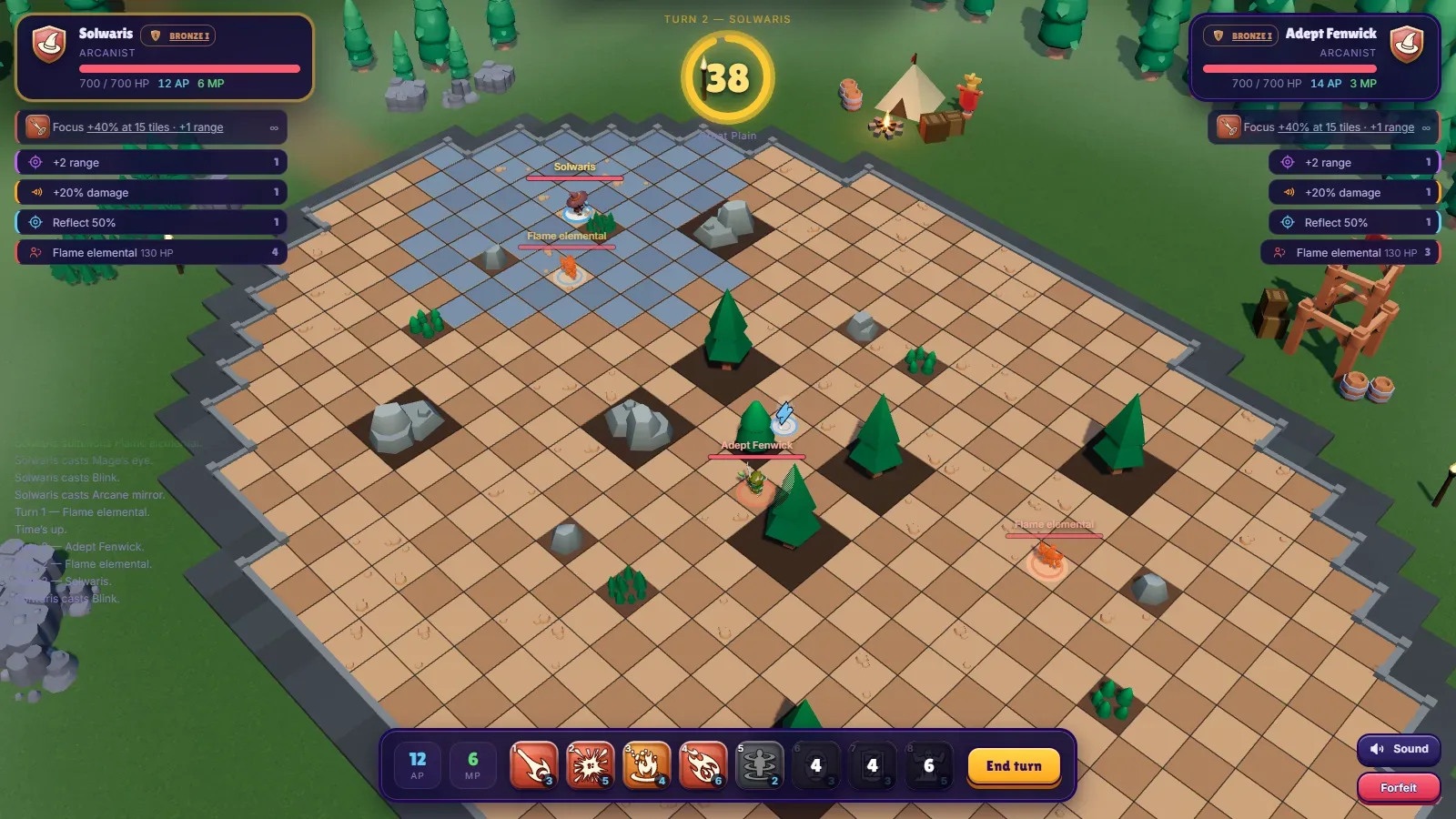
The Arcanist is the class that teaches Solwaris’s most useful lesson: distance is a resource, just like action points. They hit harder the further away they are, they have more AP than anyone, and they fold the moment a Brute reaches them. Winning with the Arcanist is less about which spell you cast and more about where you stand when your turn ends. Every number below comes from the game code, and the full class page is in the Arcanist guide.
The Arcanist at a glance
| Stat | Arcanist | What it means |
|---|---|---|
| Health | 700 | The lowest tier, shared with the Shade and the Artificer |
| Action points | 14 | Two more than every other class (12) |
| Movement points | 6 | The standard |
| AP removal resistance | 25% | Second lowest in the game |
| MP removal resistance | 20% | The lowest in the game |
The passive: Focus
Focus does two things, and both matter:
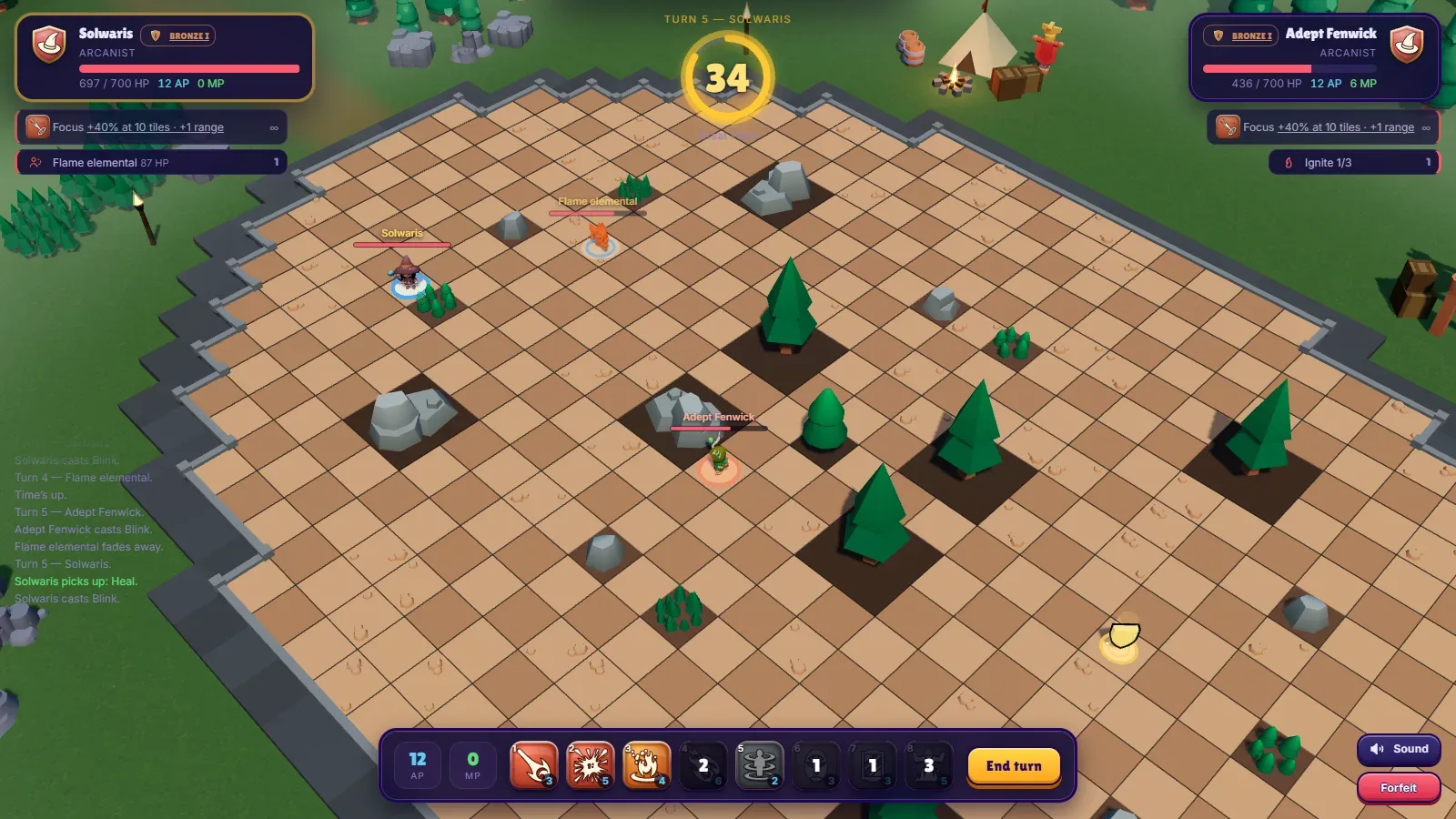
- Damage grows with distance: +5% per tile beyond 2, capped at +40% at 10 tiles. At 3 tiles you hit like anyone else; at 8 tiles you hit 30% harder. In melee, nothing.
- Every spell with a range of 2 or more reaches one tile further. Fire bolt reaches 9 tiles, Blast 8, Comet 9, Blink 4.
That second point is the one new players forget, and it is often the tile that lets you hit without being hit back.
The eight spells, and what they are really for
Fire bolt (3 AP, range 1 to 8, twice a turn, no cooldown). 16 to 24 damage, plus an Ignite mark that lasts 3 turns. On the third mark, the target explodes for 38 to 54 damage on itself and every adjacent tile. Since you can only cast it twice a turn, the third mark always lands on the next turn. Your opponent knows it, and so do you.
Blast (5 AP, range 2 to 7, 1-tile circle, 1-turn cooldown). 21 to 30 damage on a tile and the four tiles next to it. It targets a tile, not an enemy, so it can hit an invisible Shade or a hero standing next to their summon.
Blaze (4 AP, range 1 to 7, 2-turn cooldown). No immediate damage: the target burns for 17 to 25 at the start of each of its next 2 turns. Once applied, it ignores walls and distance. Cast it right before you break line of sight.
Comet (6 AP, range 3 to 8, 2-tile circle, 3-turn cooldown). 23 to 33 damage to everything within 2 tiles of the point you pick. The widest area in the class. Its minimum range of 3 means it never works on someone already hugging you.
Blink (2 AP, range 1 to 3, a free tile in sight, once a turn, no cooldown). The most important spell in the kit. Out of melee, back into line of sight, or around a corner, every turn.
Mage’s eye (3 AP, self, 4-turn cooldown). +2 range on every spell and +20% damage for this turn and the next. Fire bolt then reaches 11 tiles.
Flame elemental (5 AP, range 1 to 5, 6-turn cooldown). A summon with 130 health and 4 MP that you control on its own turn, for 4 turns. It casts Ember spit at up to 5 tiles (26 to 38 damage) and Burning breath in a straight line, which pushes the target 2 tiles back (12 to 18 damage). It also blocks a tile: in a corridor, that can be worth more than its damage.
Arcane mirror (3 AP, self, 4-turn cooldown). For 2 turns, half the damage you take is also dealt to whoever hits you. You still take the hit. It punishes melee; it does not protect you from it.
Playing range and line of sight
Distance in Solwaris is counted in tiles with no diagonals: two tiles right and three up is five. Line of sight is a straight segment from the centre of your tile to the centre of the target’s. Walls and rocks block it; the void, fighters and summons never do. See the rules for the details.
For the Arcanist, that turns into three habits:
- Pick your end tile before your first spell. The last move of your turn sets the distance your opponent starts from, and therefore how much you hit for next turn.
- Count their reach, movement included. A Brute can walk and still Charge up to 7 tiles in a straight line; a Warrior can walk and still cast Warrior’s leap at 5 tiles. Being safe usually means being off their line and behind cover, not just far away.
- Break lines, not just distance. An obstacle between you and a melee class forces them to walk, and walking costs them the movement they needed to close.
Three combos that win games
The Ignite turn (12 of 14 AP). Fire bolt, Fire bolt, Blaze: two marks and a burn running. Then Blink to set your distance. Next turn, the first Fire bolt triggers the explosion for 38 to 54 on the target and everything next to it.
The long-range turn (14 AP). Mage’s eye, Comet from far away, Fire bolt, then Blink. Every AP is spent, and your opponent starts their turn well out of reach with two turns of boosted damage still coming.
The breakaway (12 AP). They reached you. Blaze on them, Blink out, then two Fire bolts from the new tile. You leave with Focus working again, and the burn keeps ticking even if they chase you around a corner.
Matchups, class by class
| Opponent | Their threat | Your plan |
|---|---|---|
| Warrior | Warrior’s leap (2 to 5 tiles), Taunt (2 to 6, straight line) pulls you into melee | Stay off their row and column, keep an obstacle between you, cast Arcane mirror on the turn before they can land |
| Brute | Charge up to 7 tiles in a line, Roar removes MP, Quake pulls towards a point | Never end in a clear corridor, and treat your low MP removal resistance as a reason to keep your distance early |
| Shade | 6 MP, plus 2 with Shadow veil, invisibility, traps you cannot see | Blast and Comet hit tiles, so they hit an invisible Shade; avoid the obvious approach tiles |
| Clockmaker | Hourglass removes AP, swaps and recalls move you off your ideal tile | Kill the Automatons, they only have 10 health; expect to lose AP and keep Blink for after a swap |
| Artificer | Shove pushes 3 tiles, charges explode in an area, firing lines | Blast and Comet damage several charges at once, and a destroyed charge vanishes without exploding; never end your turn between two of them |
Against the Warrior and the Brute, the whole game is the gap. They win the moment they reach you; you win every turn they spend walking. Their big closing spells work in straight lines, so the tile you pick is often worth more than the spell you cast.
Against the Shade, you are the one at risk: 6 MP and the 2 from Shadow veil can cross your range in a turn. Keep your area spells for the turn they vanish, and never step into a spot they have had time to trap.
Against the Clockmaker, your 14 AP are exactly what their Hourglass targets, and their swaps can drag you out of position. Their Automatons are fragile anchors: removing them shuts down a large part of their plan.
Against the Artificer, the charges are both a threat and a target. Hit them before they gain power, and keep track of where a Shove could send you.
Common Arcanist mistakes
- Blinking at the start of the turn and then having nothing left when they close.
- Ending the turn at 6 tiles in an open line from a Brute: that is a free Charge.
- Casting Comet on someone in melee. It cannot target closer than 3 tiles.
- Forgetting the +1 range from Focus and backing off one tile too many.
- Casting Arcane mirror early, then facing the melee turn without it.
The Arcanist rewards players who plan one turn ahead. If turn-based tactics are your genre, our list of turn-based strategy games you can play in your browser has more to try, and you can play Solwaris free in your browser, with no download: a free wallet is all you need to sign up.
Sources: numbers in this guide come from the game code as of publication.
The fastest way to understand it: play a duel
Pick a hero, take your position and beat another player — or an AI — turn by turn. Nothing to install: it plays right here.
Frequently asked questions
How do you play the Arcanist in Solwaris?
By holding distance. Every tile past 2 adds 5% damage, up to 40% at 10 tiles, and almost every spell reaches one tile further. Spend your action points on Fire bolts and area spells from far away, then use Blink at the end of the turn to decide where your opponent starts.
What is the Arcanist’s best spell?
Blink, even though it deals no damage. It costs 2 AP, has no cooldown and gets you out of melee or back into line of sight every single turn. For damage, Fire bolt and its Ignite explosion are the core of the class.
How do you beat an Arcanist in Solwaris?
Get into melee. There, the Focus passive gives no bonus, and 700 health with no shield does not last long. Anything that pulls or closes the distance, such as Charge, Taunt or Quake, takes away their main strength.
Is the Arcanist good for beginners?
It is a good second class. The spells are straightforward, but survival depends on reading distance and line of sight every turn. Starting with the Brute or the Warrior teaches the basics with more room for mistakes.