Solwaris Beginner’s Guide: Your First Fight, Step by Step
A Solwaris duel takes five minutes to understand and a lot longer to master. This guide walks you through your first fight, from the selection screen to the final blow, then covers the ten mistakes almost everyone makes at first, and how to improve afterwards.
You have just opened Solwaris and six heroes are looking at you. There is no endless tutorial: the game lets you pick and sends you into the arena. This guide makes the journey with you, in the order things happen during a first fight. Every number comes from the game rules and its code.
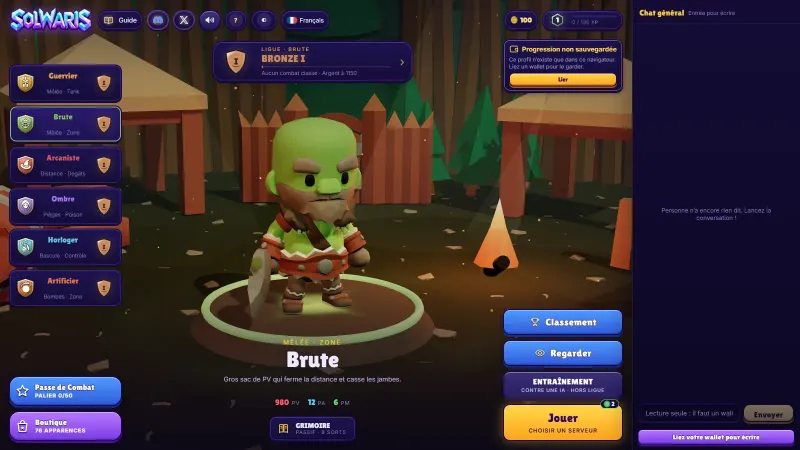
1. Picking your class
The 6 classes add up to 48 spells, eight each, and each class has a passive that changes one rule of the game. There are no levels and no gear: two players who pick the same class have exactly the same tools.
| Class | Role | Hit points | For beginners? |
|---|---|---|---|
| Brute | Melee, area | 980 | Yes: the toughest, and the more wounded it is, the harder it hits |
| Warrior | Melee, tank | 820 | Yes: permanently takes 16% less damage |
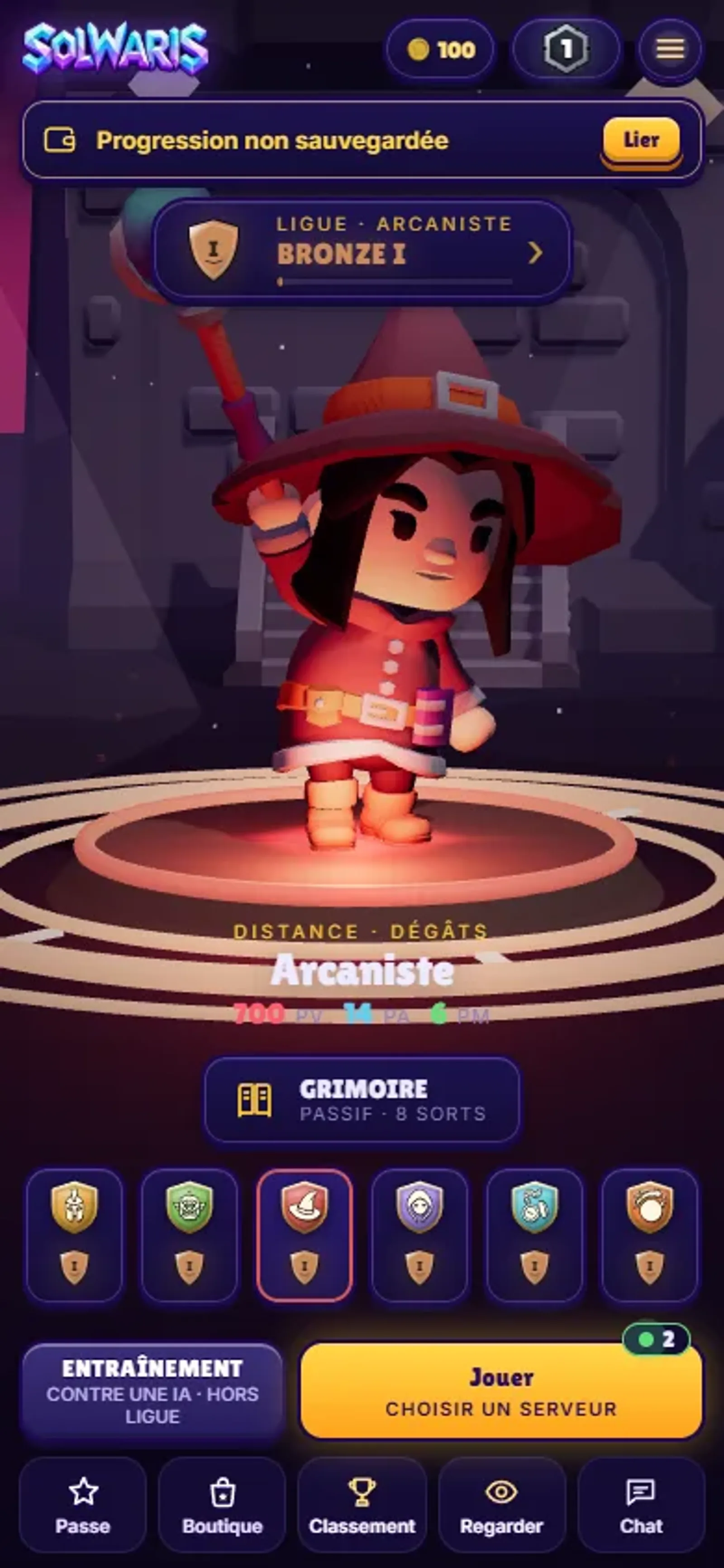
| Arcanist | Ranged | 700 | Next: 14 AP, but fragile in melee |
| Shade | Traps, poison | 700 | Later: you need to prepare the ground |
| Clockmaker | Control, place swaps | 720 | Later: the most demanding to plan |
| Artificer | Bombs, area | 700 | Later: its charges take several turns |
Our advice: start with the Brute or the Warrior. Their spells do what they say, and the instruction fits in one sentence: get into contact and stay there. You will learn distance with the Arcanist, and anticipation with the other three.
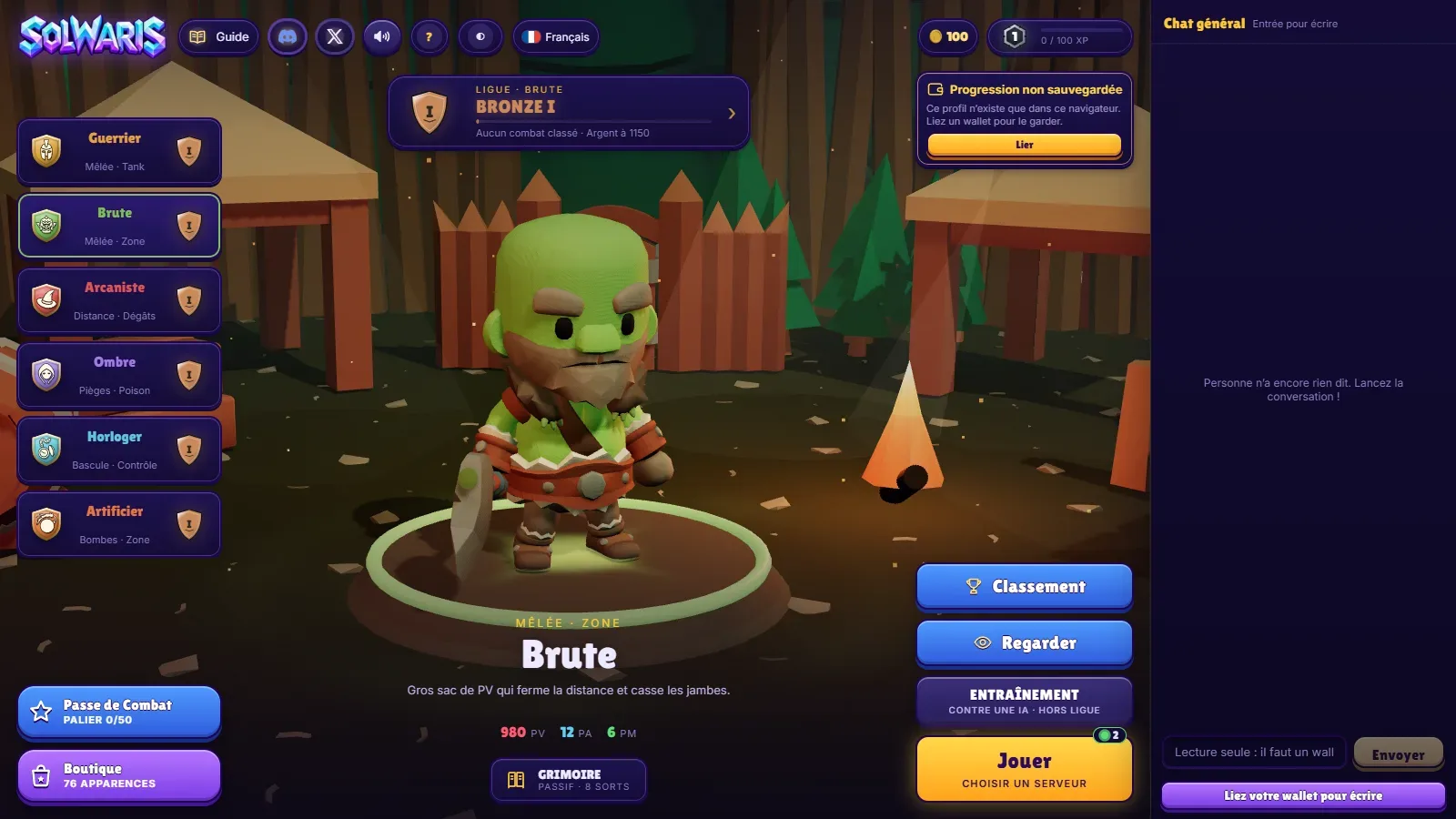
Before starting, open your class’s Grimoire: it shows the passive and the eight spells with their cost, range and cooldown. Two minutes of reading will save you plenty of wasted turns.
2. Placement
An opponent is found and the map appears. There are nine maps, from the small, cluttered Vault to the vast Great Plain. You have 25 seconds to pick your starting tile within your zone. After that, the game places you automatically.
This choice matters more than it looks:
- a ranged class sets up behind an obstacle, so it does not offer line of sight on turn one;
- a melee class faces a clear corridor, so it can close the distance quickly;
- either way, look at where the opponent is and which obstacles separate you.
3. The initiative bid
A draw decides who plays first. The other player then has 5 seconds to buy the initiative back, in steps of 100 coins (the currency you earn by playing). Each counter-bid restarts the timer. The last bidder plays first and pays the final price alone; if nobody bids, the first turn is free. Against the AI, there is no bid.
Playing first is not always an advantage. A Brute or a Warrior wants the opening; a Shade or an Artificer often prefers to let the other side step forward. At first, do not spend your coins: let the draw decide.
4. A typical turn: AP, MP and line of sight
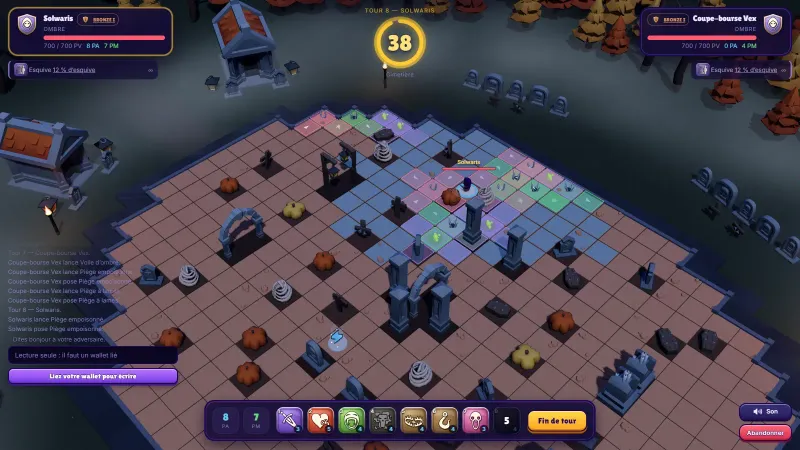
Each turn, you get 12 action points (AP) and 6 movement points (MP), with a few class exceptions: the Arcanist has 14 AP, the Shade 7 MP, the Clockmaker 5 MP. You have 40 seconds.
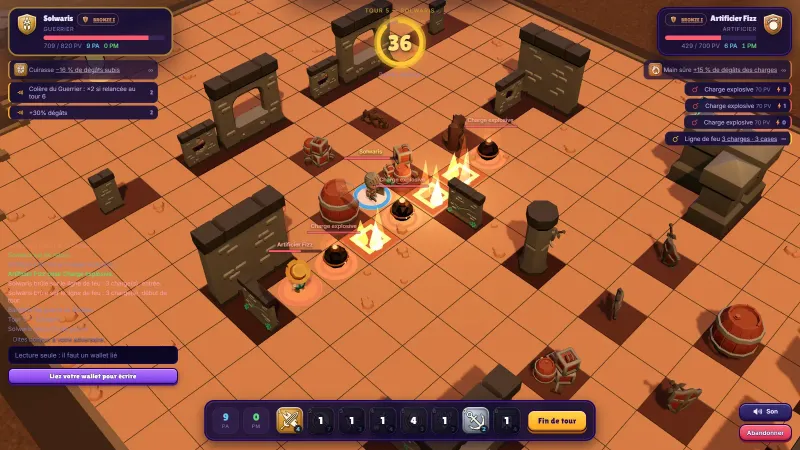
- MP pay for movement: 1 MP per tile. You cannot walk through walls, fighters, summons or placed charges.
- AP pay for spells. Each spell has a cost, a minimum and maximum range, and often a per-turn cast limit or a cooldown.
- Nothing carries over: next turn, AP and MP are back to full, and whatever you did not spend is lost.
Distance is counted in tiles, with no diagonals: two tiles right and three up make five. Line of sight is a line drawn from the centre of your tile to the centre of the target tile. A wall, a rock or the void blocks it; a fighter or a summon never does. If the line is blocked, the spell does not go off.
An example Brute turn, 6 tiles from an opponent in line with it:
- Charge (4 AP): it rushes in a straight line into contact, without spending MP, and strikes.
- Mace smash (4 AP): damage, and the target loses 12% resistance for 2 turns.
- Stomp (4 AP and 1 MP): it hits everything within 2 tiles, and removes MP.
All 12 AP are spent, and 5 MP remain to end the turn on the right tile. Meanwhile, keep an eye on the field bonuses: two appear every turn on free tiles (a 70 HP heal, 60 armour, +2 AP or +2 MP) and go to whoever steps on them.
5. Ending your turn, and winning
When you are done, click End turn, or let the timer run out. A fight ends in only three ways:
- a hero’s hit points drop to zero (summons do not count);
- a player forfeits;
- the 40-turn limit is reached: the fight is declared a draw.
At the end, the results screen breaks down the experience earned: 100 XP for a win, 60 for a draw, 40 for a loss, with bonuses for a long fight or a clean win. A fight shorter than three turns earns nothing.
The 10 beginner mistakes
- Saving AP “for later”. They vanish at the end of the turn. A good turn ends with almost nothing left.
- Moving before counting. First count the AP for your spells, then the MP you have left to position yourself.
- Forgetting minimum range. Some spells cannot be cast on an adjacent target; the Arcanist’s Comet, for example, needs 3 tiles.
- Ending your turn in the open. Almost every loss comes from a badly chosen tile: in full view of an Arcanist, stuck to a Brute, on the line of a Charge.
- Staying in line with a class that fires in straight lines. The Brute’s Charge and the Warrior’s Taunt only go in a straight line. Stepping off their line takes away their best spell.
- Walking into invisible traps. Against a Shade or a Brute, beware of the obvious tiles to cross: a trap stays there for 8 turns, and you cannot see it.
- Casting your protection too early. Bulwark, Stoneskin or Shadow veil are for the turn the opponent has all their AP, not for the first turn that comes along.
- Ignoring AP and MP removal. An opponent who removes 3 MP stops you from escaping; down 2 AP, you will not cast your big spell. Read the effects shown under your portrait and theirs.
- Chasing a target instead of playing the map. Against a ranged class, reach the blind spots; against a melee class, keep obstacles between you.
- Forgetting that progress is local. Without an account, your profile only exists in this browser, as the menu says. Switching browsers or clearing your data starts you from scratch.
Improving afterwards: AI, spectating, leagues
Training against the AI is the right testing ground. You start it from the menu; it does not count towards your league and earns 40% less experience, with no coins. Perfect for learning a new class with nothing at risk.
Spectator mode (the “Spectate” button) lets you follow fights in progress. Watching a good player of your class teaches you faster than ten losses.
Ranked leagues use an Elo rating per class: everyone starts at 1000 with each class, in Bronze. There are eight leagues, from Novice to Legend, with five tiers each. Beating a stronger player earns a lot, beating a weaker one almost nothing. So you can be a beginner with the Clockmaker and experienced with the Warrior without one hurting the other.
A word of honesty: Solwaris is a young game with a small community. At off-peak hours, finding an opponent can take time; training against the AI is there for those moments. There is also a 2 vs 2 mode for when you have found a partner.
To go further, pick a class and read its guide, or, if traps tempt you, our guide to winning with the Shade. And if you enjoy the genre, our selection of turn-based games will give you more ideas.
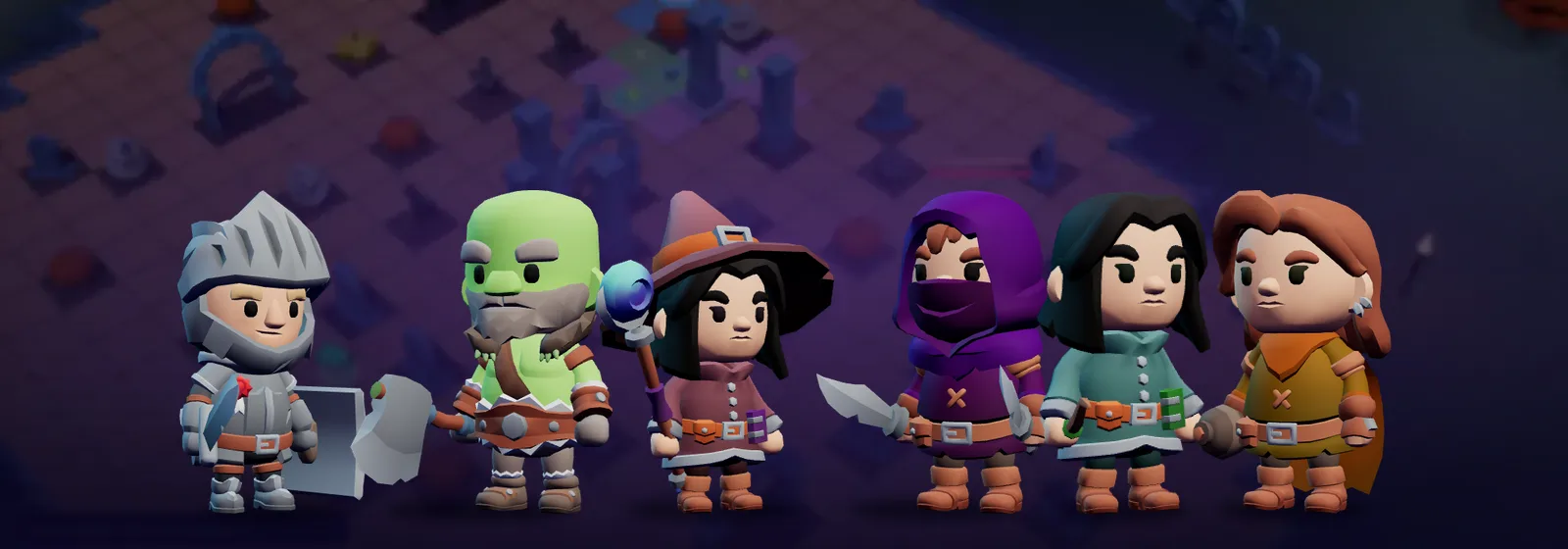
Six classes. One duel. Your strategy.
Pick a hero, take your position and beat another player — or an AI — turn by turn. Nothing to install: it plays right here.
Frequently asked questions
Which class should you start with in Solwaris?
The Brute or the Warrior. They have plenty of hit points, melee spells that are easy to read and a simple game plan, get into contact and stay there. The Clockmaker and the Artificer require the most planning and are best kept for later.
How long is a turn in Solwaris?
40 seconds at most. When the timer runs out, the turn passes to the opponent as it stands, and any unspent points are lost.
Do you need an account to play Solwaris?
No. The game opens in the browser, with no sign-up and no download. Your progress is first saved in that browser, as the menu points out.
How do you win a fight in Solwaris?
By bringing the enemy hero’s hit points down to zero, or if the opponent forfeits. If nobody has won after 40 turns, the fight is declared a draw.