What Is a Tactics Game? The Mechanics Behind a Good Fight, Explained Simply
A tactics game is not just “a game where you think”. It is a handful of precise rules, the same from one game to the next, that turn a tiled board into a two-player puzzle. Here are those mechanics, one by one, with concrete examples.
A tactics game has a simple definition: you lead a few fighters through one specific clash, and you win through placement and the order of your actions. No city to manage, no army of a hundred units, no reflexes. Just a board, rules both sides know, and the question that comes back every turn: what do I do with this turn?
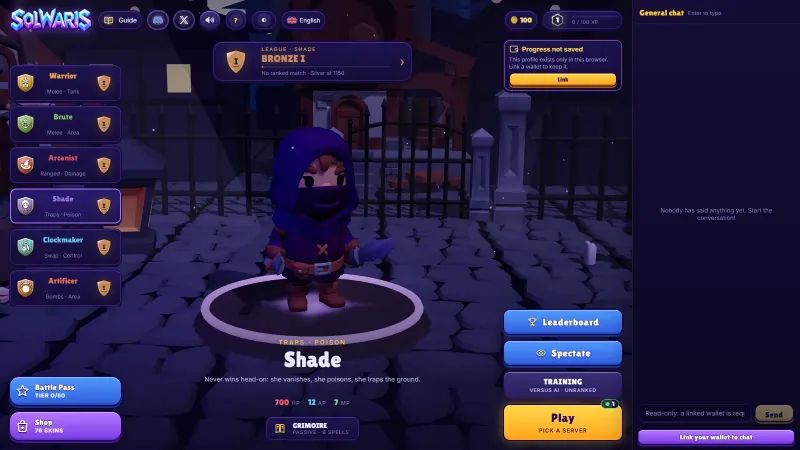
Behind that simplicity, almost every tactics game is built from the same bricks. Understanding them means understanding why one game is deep and another is merely long. This article takes them one at a time, with examples from well-known games and from the rules of Solwaris, a tactical duel you can play in a browser.
Tactics or strategy: where is the line?
The two words are often confused. Strategy plays out above the fight: which resources to produce, where to send your troops, when to declare war. Tactics play out inside the fight itself: which tile to hold, which unit to hit first, when to fall back.
Civilization is a strategy game that contains battles. XCOM 2 is a tactics game: each mission is a fight where you move a few soldiers from cover to cover. Many games mix both levels, but a “tactics game” in the strict sense is one where the fight is the game.
Most tactics games are turn-based, because tactics need time to read the board. If you are after a list of titles rather than an explanation, see our pick of the best free turn-based games.
The turn budget: action points and movement points
This is the foundation. Every turn, a unit receives a budget, and every action spends some of it. The whole game is about spending that budget as well as possible.
There are two big families:
- Action-based budgets. In XCOM 2, each soldier has two actions per turn: move, shoot, or go on overwatch. Simple and readable.
- Point-based budgets. In Divinity: Original Sin 2, a character receives 4 action points per turn, capped at 6, and unspent points carry over to the next turn. In Dofus, AP (action points) pay for spells and MP (movement points) pay for moving.
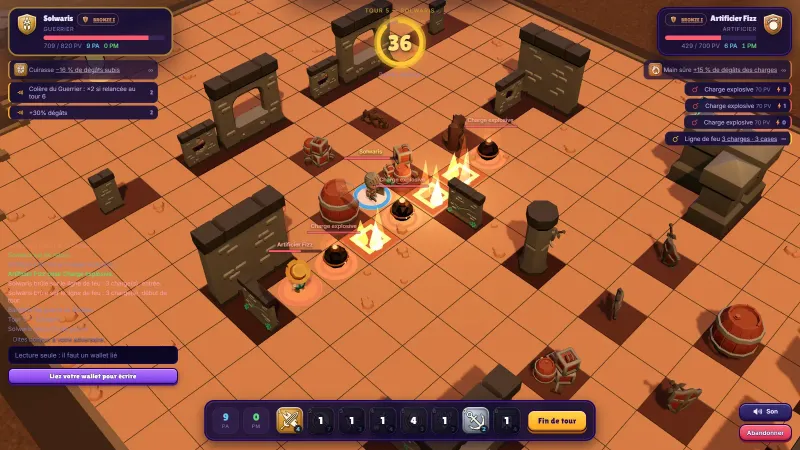
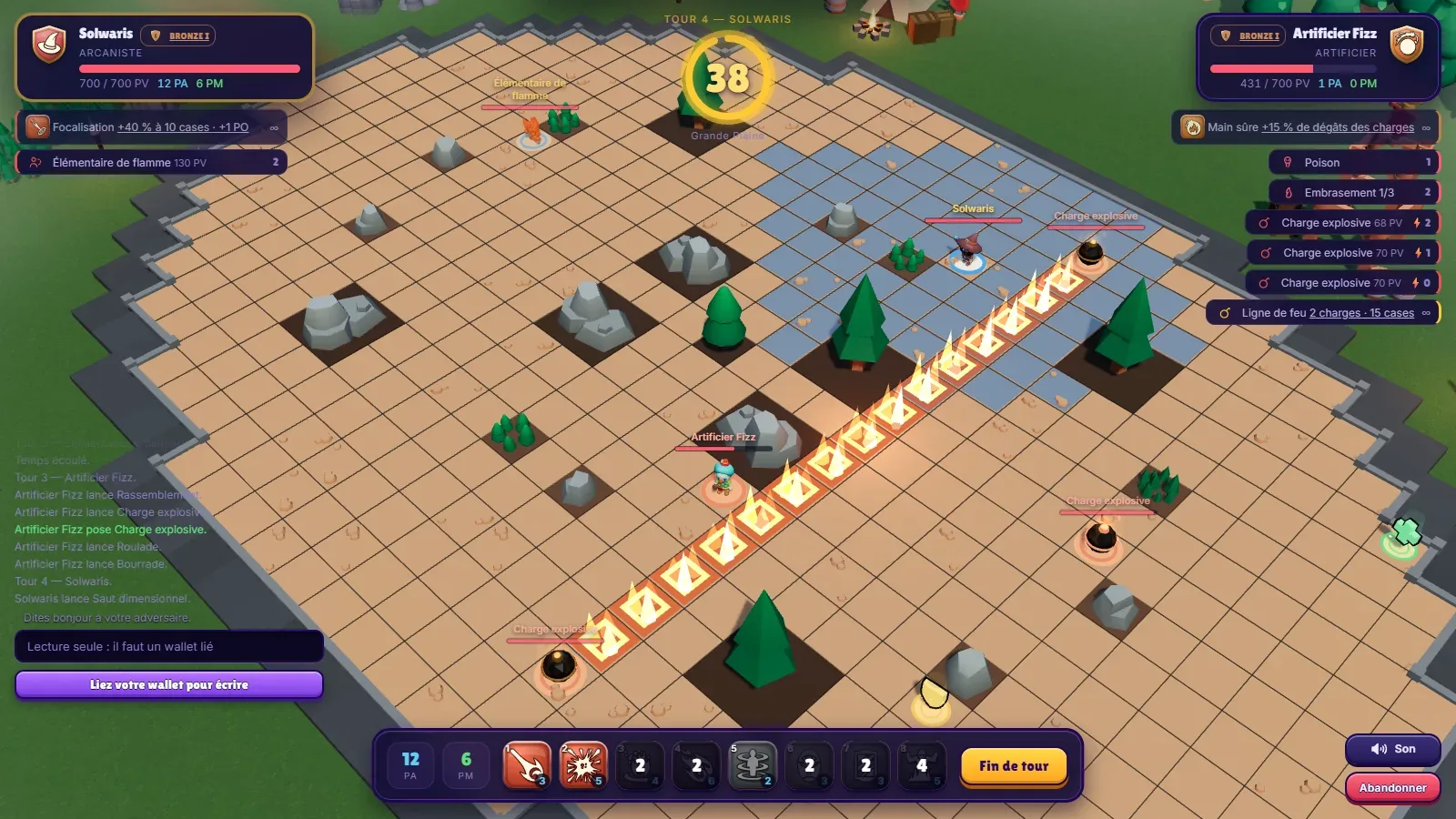
Solwaris keeps the AP / MP split: every turn, a fighter has 12 AP and 6 MP, with class exceptions (the Arcanist goes up to 14 AP, the Shade to 7 MP). And unlike Divinity, nothing carries over: whatever is not spent is lost.
That detail changes everything. With carry-over, you can “save up” for a big turn. Without it, every turn is a small optimisation problem: the Arcanist with 14 AP can cast a Comet (6 AP) and two Fire bolts (3 AP each), or keep enough to teleport with Blink (2 AP). A good turn, in this system, is one where almost nothing is left.
Range and line of sight: the scenery becomes a weapon
An attack cannot land just anywhere. Two rules decide what you can target.
Range is a minimum and maximum distance, counted in tiles. In Solwaris, distance is counted “in steps”: two tiles right and three up make five tiles, and diagonals do not shorten anything. Minimum range matters as much as maximum range: the Arcanist’s Comet reaches from 3 to 8 tiles, so an opponent standing right next to her is out of reach of her biggest spell. Getting up close to a spellcaster is a tactic in itself.
Line of sight is a line drawn between your tile and the target tile. If a wall cuts it, no shot. In Solwaris, only the scenery blocks sight: a fighter or a summon blocks movement, never vision. A few spells ignore it, such as the Artificer’s Ignition, which detonates a charge wherever it is.
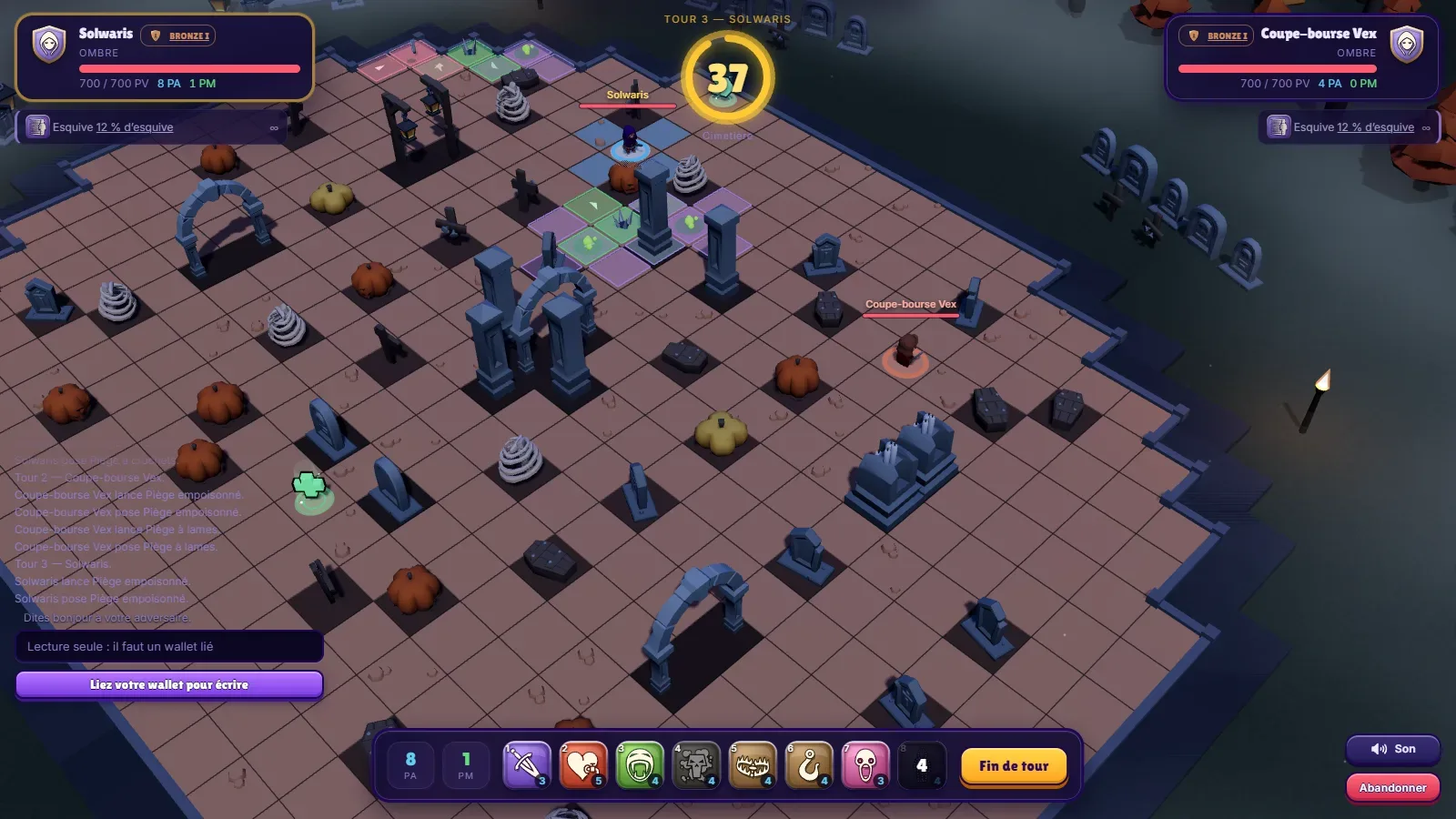
XCOM 2 takes the logic further with cover: a soldier behind a low wall is harder to hit, and the game shows the percentage chance before you shoot. Either way, the effect is the same: the terrain matters as much as the units. Walking into the open in the middle of an aisle is handing over the first hit.
Areas, pushes and collisions: playing with positions
The richest tactics games do not settle for removing health points. They move units.
- Area effects hit several tiles at once: a cross, a circle, a line. They punish grouped units and force you to spread out.
- Pushes and pulls change a target’s position. In Into the Breach, this is the heart of the game: on an 8 by 8 grid, enemies announce their attacks in advance, and you often win by pushing them so they hit each other.
- Collisions turn a push into damage. In Solwaris, a target pushed into a wall or another unit stops dead and takes damage for every tile it could not travel. The Artificer’s Shove (2 AP) pushes three tiles: against an obstacle, it is a damage spell in disguise.
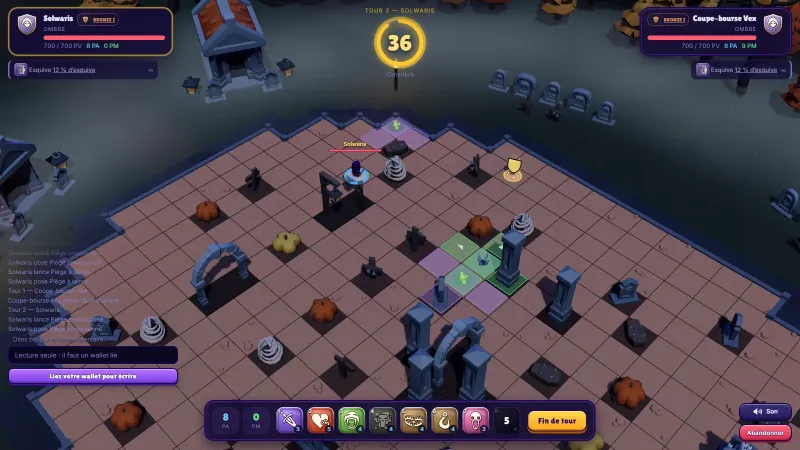
These mechanics combine. In Solwaris, the Shade lays invisible traps, then uses Fear to send the opponent fleeing straight onto them. A trap placed at random gets walked around; a trap you push your target onto goes off every time.
Initiative: who goes first?
In a turn-based game, the order of play is an advantage, or a handicap. Each game settles it in its own way:
| Game | Who starts? |
|---|---|
| Chess | Always white |
| Baldur’s Gate 3 | A dice roll, modified by Dexterity, fixed for the whole fight |
| Solwaris | Chance picks a player, then the other can buy the first turn at auction, with coins earned by playing |
Going first is not always desirable. A class that hits in melee wants the opening; a class that lays traps or charges often prefers to let the other side come forward. In Solwaris, the initiative auction is therefore the first real choice of the fight: how much is starting worth to you?
Control: attacking without dealing damage
The last brick, often the most underrated: taking options away from your opponent. An opponent who can no longer move can no longer flee; an opponent robbed of a few action points will not cast their big spell.
In Solwaris, the Clockmaker steals AP with Hourglass, the Brute removes MP with Roar, and the Warrior makes itself immune to displacement with Anchor. Each class resists these removals more or less well: that is what makes a control duel so tense.
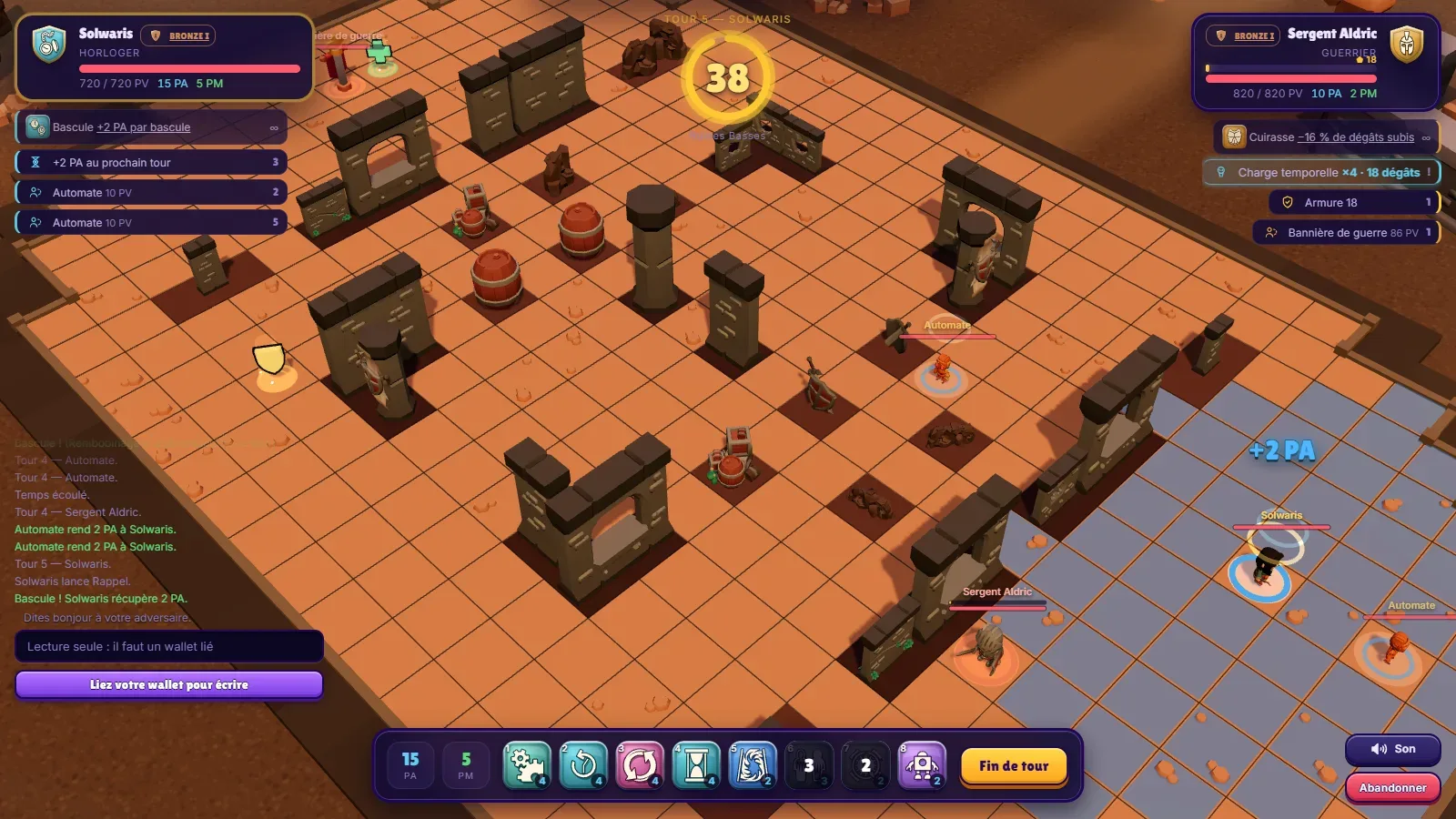
Control exists everywhere under other names. XCOM 2’s overwatch is control: a soldier on overwatch fires at any enemy that enters their field of view, which stops the opponent from advancing freely. Fire Emblem’s weapon triangle (sword beats axe, axe beats lance, lance beats sword) is a form of control by threat: you place your units so the enemy only has bad trades.
Luck: how much is enough?
A tactics game lives on predictability. If the dice decide everything, the best plan is worthless. Games in the genre therefore dose their luck:
- A lot in XCOM 2, where every shot has a displayed hit chance. You think in probabilities.
- Almost none in Into the Breach, where enemy attacks are announced before your turn.
- None in chess.
- At the margins in Solwaris: a spell’s damage varies between a minimum and a maximum, and a critical hit has a 10% chance to land. Everything else, including line of sight and pushes, is fully deterministic.
No dose is better than another; you just need to know which one you enjoy. If you want to learn tactics, a low-luck game teaches more: when you lose, you know why.
Where to start
The best way to understand these mechanics is to see them in play. Three options, depending on your time:
- Ten minutes, with nothing to install: a Solwaris duel against a Training AI. The rules fit on one page, and the rules guide details every mechanic mentioned here. It is a young game with a small community: at off-peak hours the queue can stay empty, and Training against the AI (a separate mode, outside the leagues) fills the wait.
- An evening: Into the Breach, the most readable tactics game there is, paid on PC and consoles.
- A campaign: XCOM 2, or a Fire Emblem if you prefer characters and story.
And if Dofus is what made you love AP and MP, read our Dofus alternatives.
 ArcanistRanged · Damage
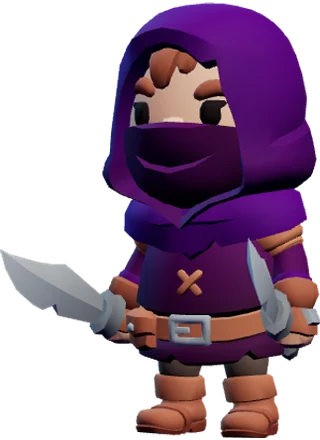 ShadeTraps · Poison
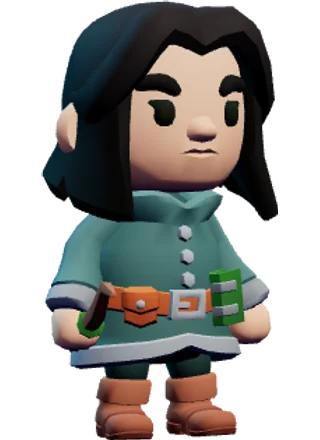 ClockmakerSwap · Control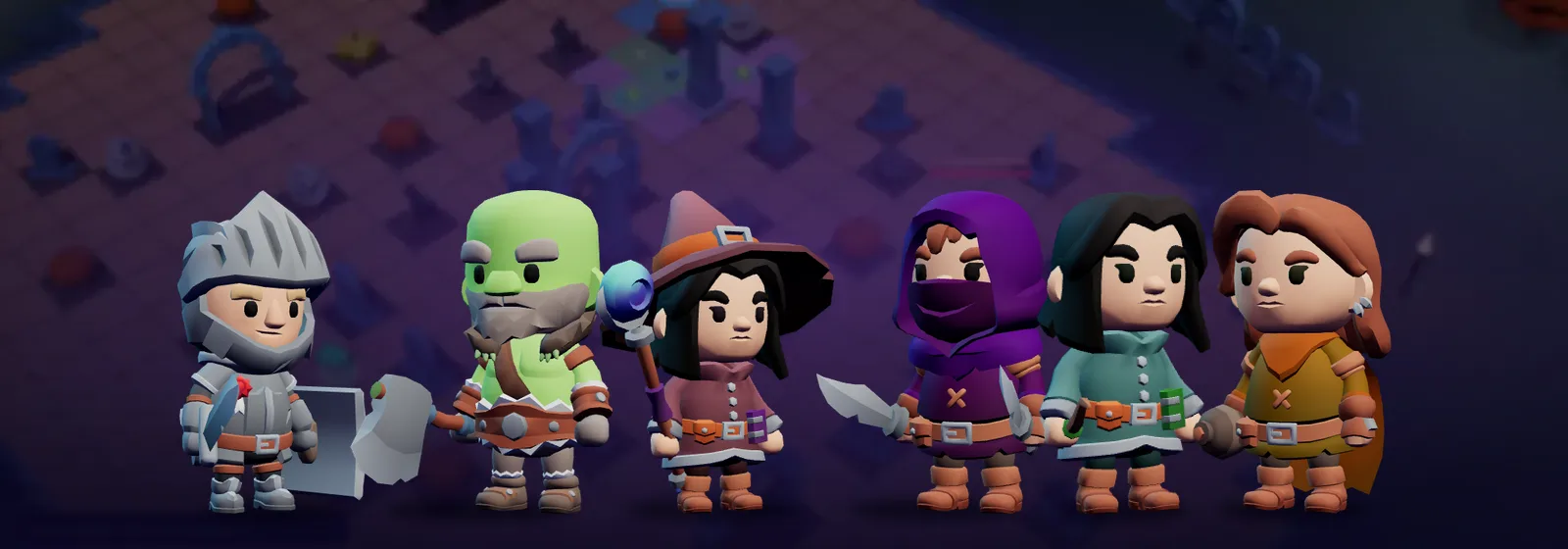
Six classes. One duel. Your strategy.
Pick a hero, take your position and beat another player — or an AI — turn by turn. Nothing to install: it plays right here.
Frequently asked questions
What is a tactics game?
It is a game where you lead a few units through one specific fight, choosing their placement and their actions. You win through position and the right order of moves, not through reflexes or the size of your army.
What is the difference between a tactics game and a strategy game?
Strategy plays out at a large scale and over time, with an economy, a map or a campaign. Tactics play out at the scale of one fight, tile by tile and turn by turn. Many games combine both levels.
What do AP and MP mean in a tactics game?
AP stands for action points, the budget that pays for attacks and spells. MP stands for movement points, the budget that pays for moving. Dofus, for example, works with these two budgets.
What is line of sight?
It is the rule that says whether a unit can target a tile. You draw a line between the two tiles; if an obstacle cuts it, the attack is impossible. It makes the scenery as important as the units.