Skill-Based Games for Money: How PvP Stakes Work, and What to Check First
A skill-based game for money is only as fair as three things you rarely see: where the stakes sit during the match, who you are matched against, and how much luck is left in the rules. Here is how each works, what to check before you stake anything, and why the law depends on where you live.
Skill-based games for money have an appealing promise: no dice, no slot machine, the better player wins. That promise holds only if the game is built for it. A stake is fair when the rules leave little to luck, when the money is safe during the match, and when the person across the board is a real player of your level. This guide explains how each of those works, what to check before you stake, and where the law stands. It is not a list of apps: it is what you need to judge any of them.
Skill vs chance: where the line sits
Almost every game mixes skill and luck. Chess has none of the second; poker has plenty of both; a slot machine has none of the first. The useful question is not “is there any luck?” but “over many matches, does the better player reliably win?”
US law puts it in similar terms. States rely on one of three main tests, as summarised by the law firm Walters Law Group:
| Test | The question it asks | How strict |
|---|---|---|
| Dominant factor | Does skill decide the outcome more than chance? | The most permissive |
| Material element | Does chance play a significant role, even if skill dominates? | Stricter |
| Any chance | Does chance affect the outcome at all? | The strictest |
Skillz, a real-money skill gaming platform, summarises the usual definition of gambling as three elements together: a prize, a paid entry, and an outcome decided by chance. Remove chance, the argument goes, and it is not gambling. That argument works in some places and not in others, which is why the legal section below matters.
For you as a player, the practical version is simple. Before staking, find out exactly where the randomness is: card draws, critical hits, random maps, loot, turn order. The less there is, and the better you understand it, the more your results depend on you.
How a PvP stake works, step by step
A fair stake between two players goes through five stages. Each one is a place where things can go wrong, so each deserves a question.
- Matchmaking. The platform pairs two players who chose the same stake. Ideally it pairs players of similar level, and never the same person under two accounts.
- Locking the stakes (escrow). Both stakes are set aside before the match starts, so neither player can refuse to pay after losing. Where they sit matters: a shared pool, the platform’s own account, or an address dedicated to that match.
- The match. Rules, time limits, disconnection handling and anti-cheat all apply here.
- Settlement. The winner receives the pot minus the platform fee. A draw should give both stakes back.
- Disputes. What happens after a crash, a timeout or a suspected cheat? A serious platform tells you before you play.
Fair matchmaking: Elo, smurfs and bots
Elo and ratings. The Elo system, invented by Arpad Elo, was adopted by the US Chess Federation in 1960 and by FIDE in 1970. Each player has a rating; beating a stronger player earns more points than beating a weaker one. For stake matches, ratings matter for one reason: a fair stake is a stake against someone of your level. If the platform pairs you at random, a newcomer can end up paying for an expert’s practice.
Smurfs and multi-accounts. A strong player on a fresh account has a low rating and farms beginners. Good platforms limit this by tying stake play to a verified account or wallet, and by refusing to pair the same person against themselves.
Bots. In 2023 a proposed class action in the United States accused AviaGames, the maker of Pocket7Games and Solitaire Clash, of matching paying players against bots while advertising games against real people. These are allegations, not a ruling, but they show the right question to ask: can the platform guarantee your opponent in a stake match is human?
Anti-cheat. In a turn-based game, the main risks are collusion (two accounts of the same person, or friends trading wins) and outside help. In real-time games, add aim bots and speed hacks. Look for a published policy and for evidence that it is enforced: bans, voided matches, refunds.
The legal side: it varies, a lot
We are not lawyers, and this is not legal advice. But the broad picture is clear enough to show why you should check.
- United States. Legality is decided state by state. Skillz’s own documentation lists several states where its real-money contests are not offered at all, and others where only some games are.
- France. The Internal Security Code bans games that combine a paid stake with the hope of a gain, and its article L320-1 states that the ban also covers games based on players’ know-how. Paid video game competitions are exempted only when held with players physically present. Since 2010, only three online sectors have been opened to licensed operators: horse racing, sports betting and poker.
- Elsewhere. Rules range from permissive to outright bans, sometimes with age limits, licences or tax obligations on winnings.
A checklist for any skill-based game for money
- Where is the luck? List every random element. Fewer is better.
- Where are the stakes during the match? Escrow per match, a shared pool, or the platform’s account?
- What is the fee? Expressed on the pot or on the stake? Work out what the winner actually receives.
- Who are you matched against? By rating? Can you be matched against a bot in a paid match?
- Can money buy an advantage? Paid items that change the odds turn a skill game into a pay-to-win one.
- What happens on a disconnect or a draw?
- Can you practise for free at the same game, against real players, before staking anything?
- Is it allowed where you live?
How Solwaris answers those questions
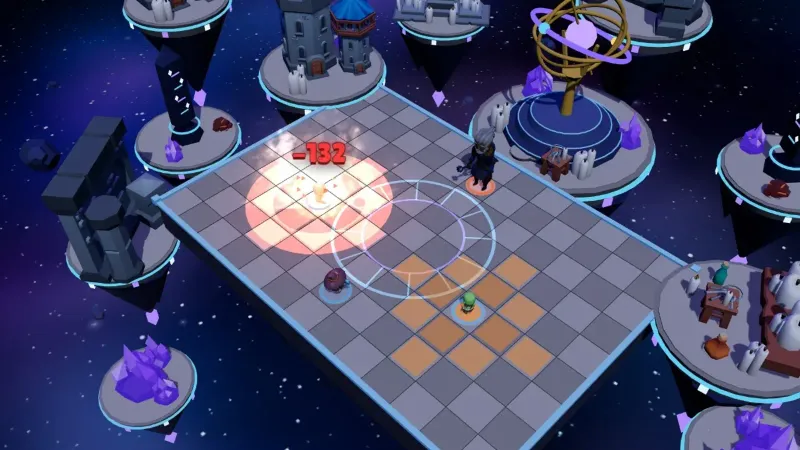
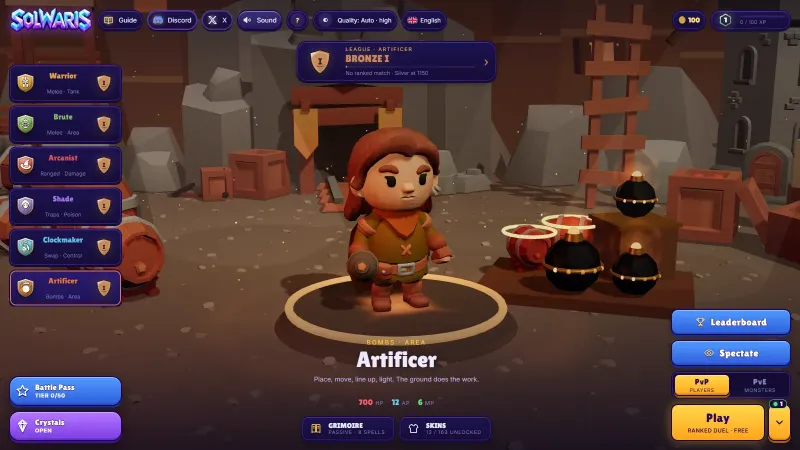
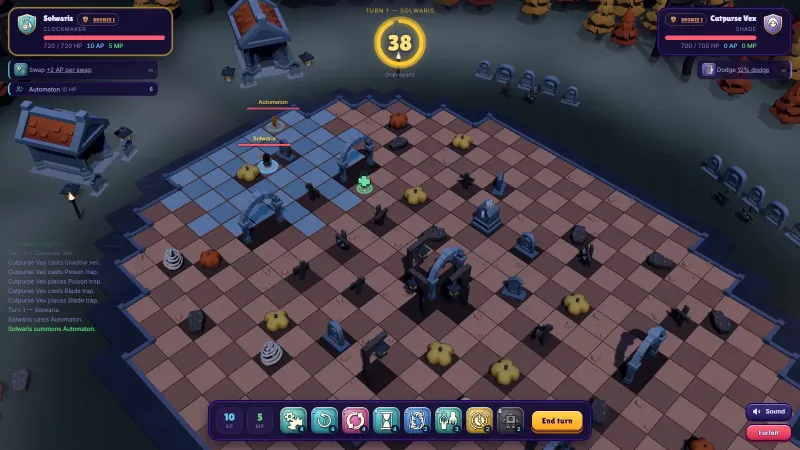
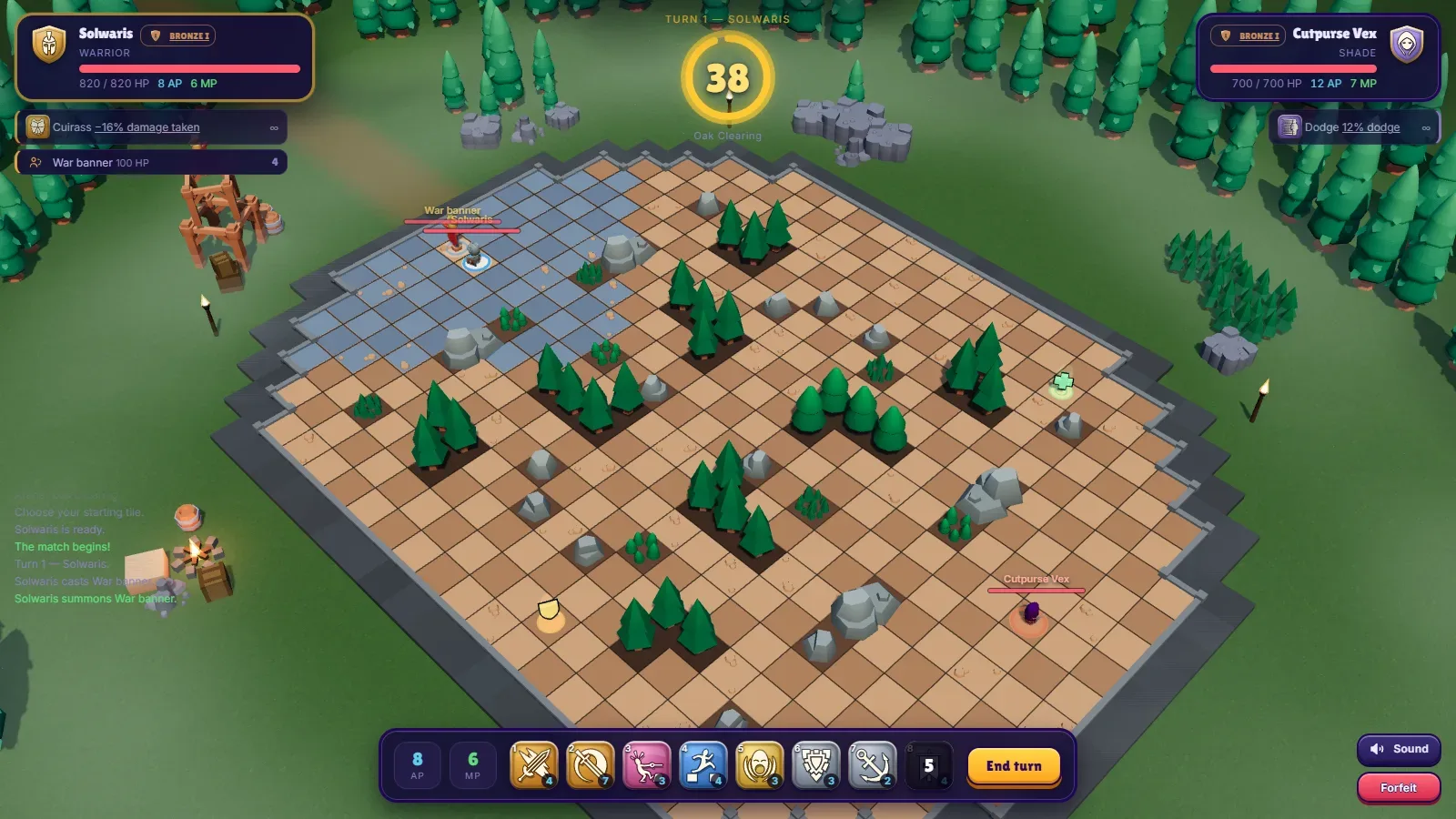
Solwaris is a 1v1 turn-based tactics game in the browser. Here are its answers to the checklist, taken from its code and economy guide.
- Luck. Each turn you spend 12 action points and 6 movement points on moves and spells. The only random element is critical hits, at 10%. Who plays first is decided by a draw, then an initiative bid paid in coins earned in play, never in USDC.
- Escrow. Both stakes move to an address dedicated to that single match. A draw returns each stake. Your USDC stays in your wallet until then, under a capped delegation you can revoke.
- Fee. Stakes are 1, 5 or 10 USDC; the winner takes the pot minus 12.5%, which is 17.50 USDC on a 10 USDC duel.
- Matchmaking. Stake queues pair two players with the same stake, never the same wallet on both sides, and prefer the closest rating. There is a separate Elo rating per class.
- Pay-to-win. None: cosmetics lower the fee but change no damage, range or rule.
- Free practice. The whole game, ranked leagues included, is free with no wallet.
- Limits. The community is small, so stake queues can be slow. And real-money duels are restricted in some countries, France included: check yours first.
The bottom line
A skill-based game for money is worth your stake only if luck is small, escrow is clear, the fee is published and your opponent is a real player of your level. Even then, the maths is unforgiving: you need to be clearly better than the people you face, and you will lose stakes along the way.
If you are new to the topic, start with our guide to P2E models, and use the red-flag checklist before connecting a wallet anywhere.
This article is not legal or financial advice. Staked matches can be lost.
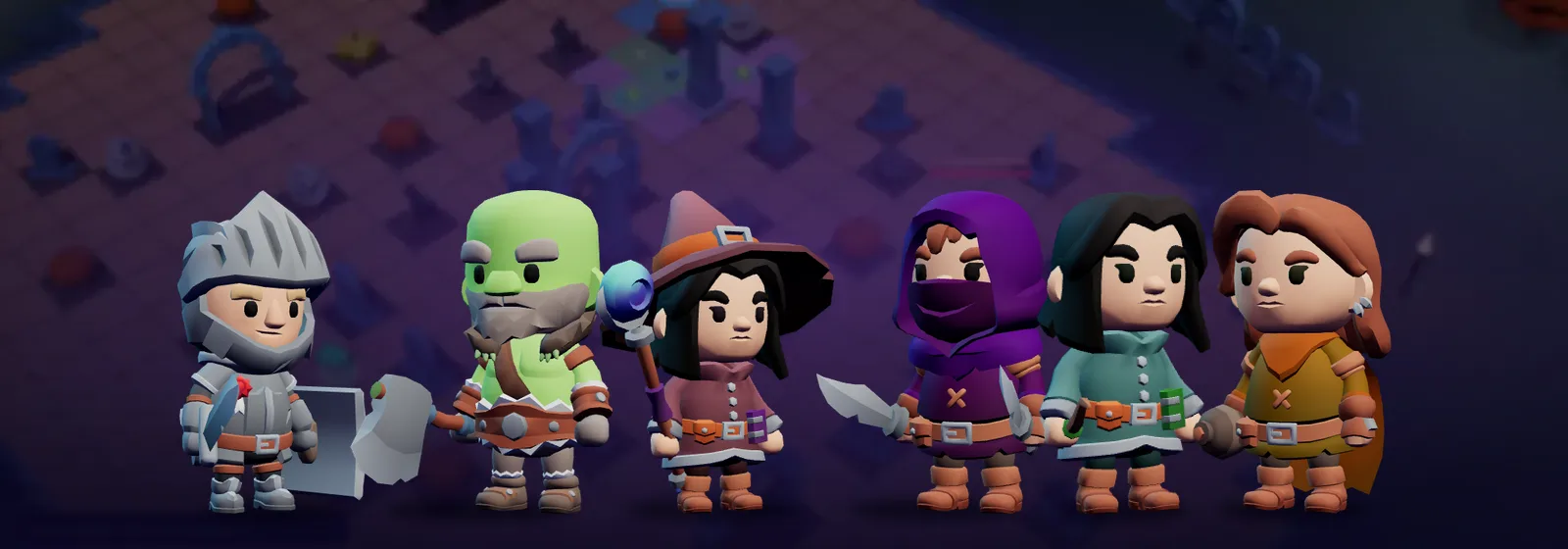
Six classes. One duel. Your strategy.
Pick a hero, take your position and beat another player — or an AI — turn by turn. Nothing to install: it plays right here.
Frequently asked questions
What is the difference between a game of skill and a game of chance?
In a game of skill, the result depends mainly on the players’ decisions and ability, so a better player wins more often over many matches. In a game of chance, luck decides the result whatever you do. Many games mix both, and the law in each country decides where the line sits.
Are skill-based games for money legal?
It depends on where you live. In the United States it is decided state by state, and several states exclude real-money skill contests. Some countries, France among them, restrict paid online competitions even when they are based on skill. Check your local law before staking.
How do I know a skill game is not rigged?
Look for clear rules with little or no randomness, a published fee, stakes held in escrow during the match, matchmaking against real players of a similar rating, and a clear policy on cheating and disconnections. Be wary of any platform that cannot tell you whether your opponent is a human.
Can you lose money in skill-based games?
Yes. Every stake you win was lost by someone else, and the platform takes a fee on top. Over many matches, only players who are clearly stronger than their opponents come out ahead. Only stake what you can afford to lose.