Online Turn-Based Strategy Games With Ranked PvP: Ladders, Elo and Where to Compete
Casual games are fine, but at some point you want a number that tells you how good you are, and opponents who push you to get better. Here is how ranked turn-based strategy works online, from the maths behind Elo to the ladders worth climbing in 2026.
There are plenty of online turn-based strategy games. Far fewer have a ranked mode worth taking seriously: a rating that actually measures skill, matchmaking that respects it, and enough players to make the climb mean something.
This guide covers three things: how ranked ladders work, what an Elo rating is (without the maths headache), and where you can compete right now in a browser.
Ranked, ladder, league: what the words mean
- Rating: a number that estimates your strength. Elo and Glicko are the two big families.
- Ladder: the ranking of all players by rating. You "climb" it by winning.
- League or tier: a named band of ratings (Bronze, Gold, Legend…), easier to read than a raw number.
- Season: a fixed period after which some rankings reset, so the top spots stay contested.
A good ranked mode uses the rating for two jobs at once: showing your level, and choosing your opponents. The second job matters more. A fair match against someone of your level is how you improve.
Elo, explained simply
The Elo system was created by Arpad Elo, a physics professor and chess master, and adopted by the US Chess Federation in 1960 and by FIDE in 1970. Its idea fits in one sentence: your rating predicts your results, and it moves when you beat the prediction.
Step 1: the rating gap gives a prediction
The gap between two ratings says how often the stronger player should win.
| Rating gap | Expected score of the stronger player |
|---|---|
| 0 | 50% |
| 100 | about 64% |
| 200 | about 76% |
| 400 | about 91% |
"Expected score" counts a win as 1, a draw as half and a loss as 0. A 200-point favourite should average about three wins in four.
Step 2: the result is compared to the prediction
After the game, your rating moves by a fixed factor, called K, times the difference between what happened and what was predicted.
Take Solwaris, which uses a classic Elo with K = 28 once your first matches are behind you:
- You beat an equal opponent: you were expected to score 0.5, you scored 1. You gain 28 × 0.5 = 14 points.
- You beat someone rated 200 above you: expected 0.24, scored 1. You gain about 21 points.
- You beat someone rated 200 below you: expected 0.76. You gain only about 7 points.
- You lose to that weaker player: expected 0.76, scored 0. You lose about 21 points.
That is the whole trick. Beating stronger players pays a lot, beating weaker ones pays little, and losing to weaker ones costs a lot. Over many games, your rating settles where you win about as often as you lose.
Glicko and Glicko-2: Elo with a confidence meter
Elo treats every rating as equally certain. Glicko adds a rating deviation: how sure the system is about your number. Chess.com uses Glicko, and its help center explains that a new player’s rating swings a lot in the first games, and that the uncertainty grows again if you stop playing for a while. Glicko-2, used by Lichess, adds a volatility measure on top. New Lichess players start at 1500, and Lichess even awards slightly more points for results with the black pieces, to account for White’s first-move advantage.
Where to compete: ranked turn-based strategy in a browser
| Game | Genre | Rating system | Ranked format |
|---|---|---|---|
| Lichess | Chess | Glicko-2 | Live and correspondence, per time control |
| Chess.com | Chess | Glicko | Live and Daily |
| Online-Go.com | Go | Its own rating, shown with kyu and dan ranks | Live, correspondence, ladders, tournaments |
| Advance Wars By Web | Wargame | Rating per format | Global League (asynchronous 1v1) and Live League |
| Board Game Arena | Board games | Elo per game, plus Arena | Seasons of three months |
| Gods Unchained | Card game | Ranks with win points | Ranked mode matched by skill |
| Solwaris | Tactical duel | Elo per class | Eight leagues, from Novice to Legend |
Chess and Go: the deepest ladders
If you want an opponent at any hour, start with chess or Go, which have large, long-established online communities. Lichess is free with no ads, Chess.com free with optional memberships, and Online-Go.com offers ladders and tournaments on top of rated games.
Advance Wars By Web: the wargamer’s ladder
AWBW’s Global League runs ranked asynchronous 1v1 games in three separate formats: standard, fog of war and high funds, each with its own ranking. Every few hours, the league creates new games for you against opponents with a similar rating, up to the number of games you asked for. A newer Live League covers real-time sessions.
Board Game Arena: seasons on top of Elo
Board Game Arena keeps an Elo rating for each game and adds an optional Arena mode with seasons of three months. You climb leagues with points that depend on your opponents’ league, and the top league uses its own Elo-style score, starting at 1500 each season. It is a good fit if you like variety: one account, many ladders.
Gods Unchained: ranked cards
In Gods Unchained, a browser card game, ranked mode matches you with players of the same skill level regardless of deck strength, and each win earns win points that move you up the ranks, up to Mythic. Cards are tradable NFTs, which is worth knowing even if you never touch that side.
Solwaris: one rating per class
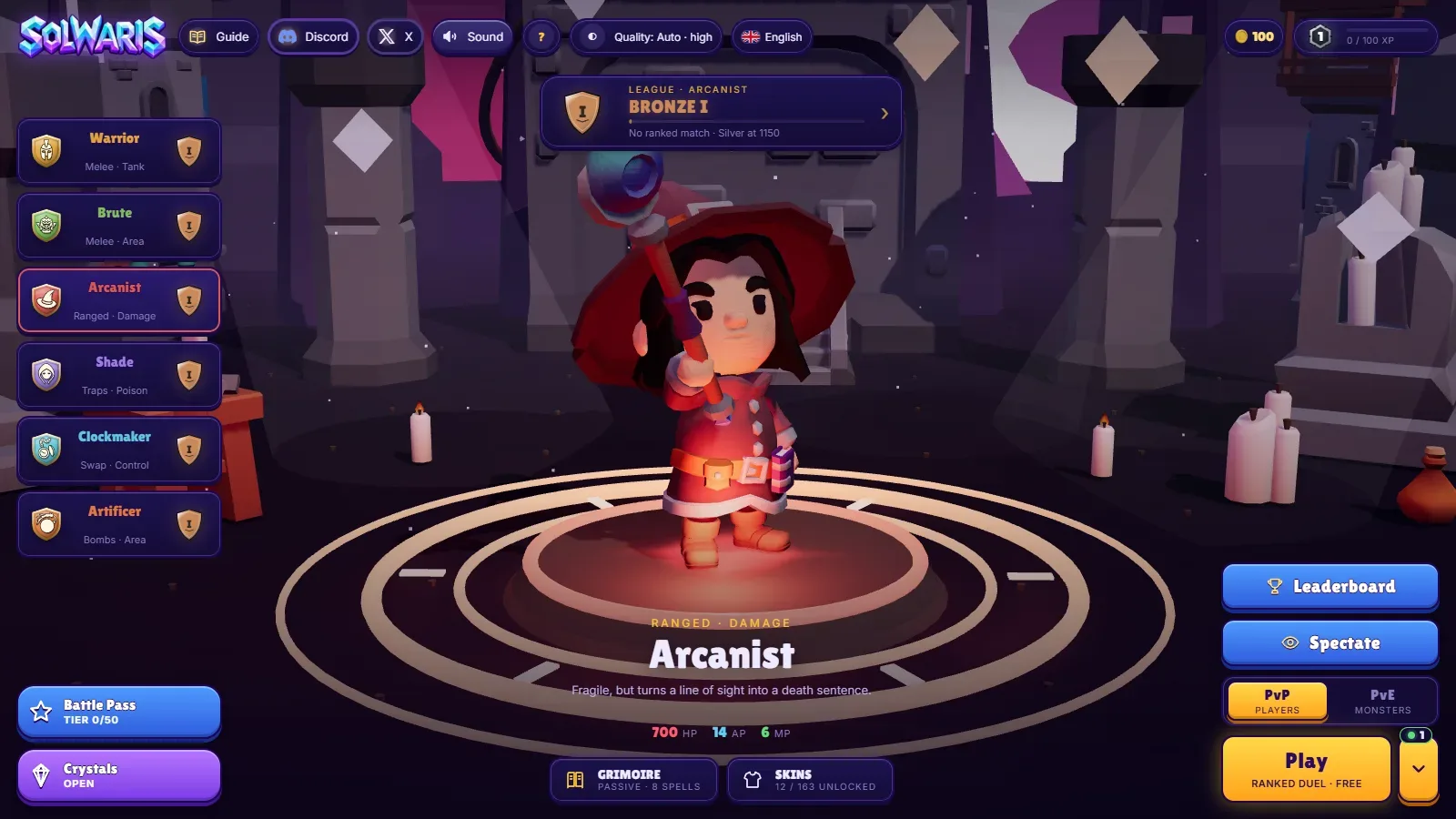
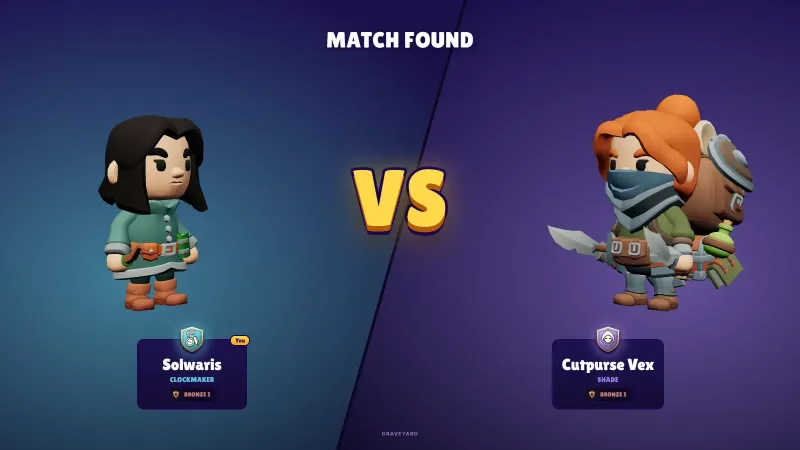
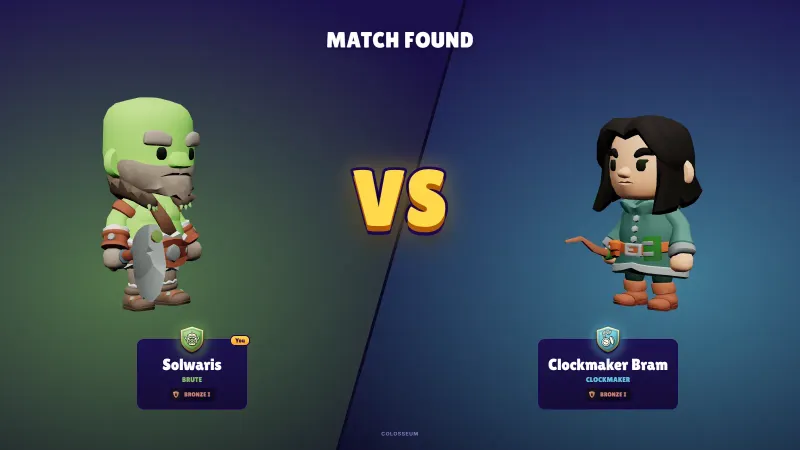
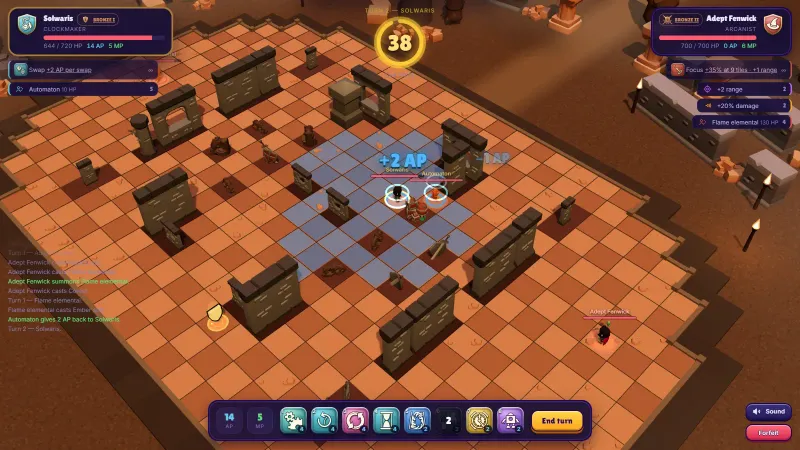
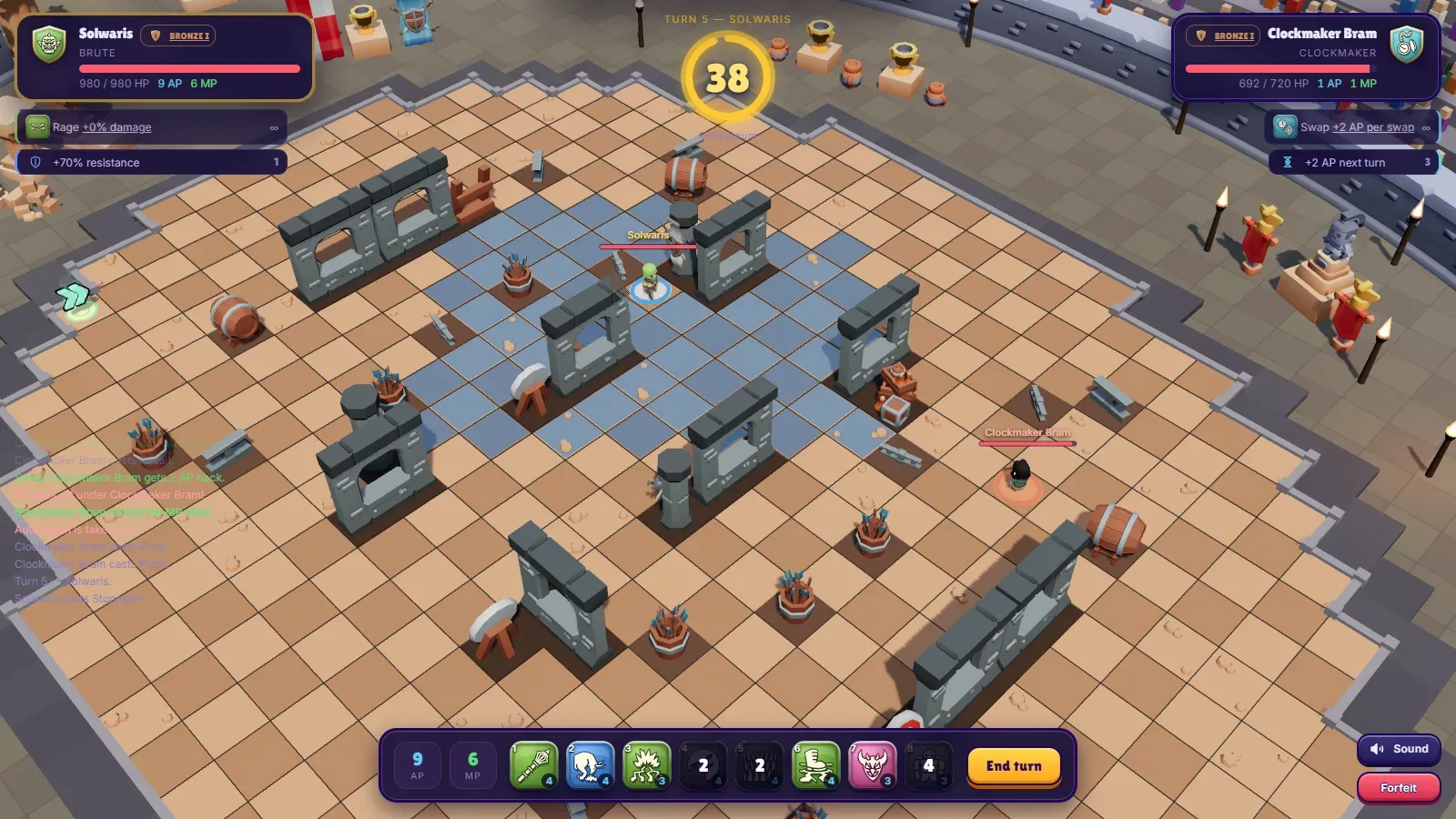
Solwaris is a turn-based 1v1 tactical duel in the browser, and its ranked mode has one detail that sets it apart: your rating is tracked separately for each of the 6 classes. Being a Legend with the Warrior says nothing about your Shade, so switching class does not wreck your main ladder, and when you queue with the Shade, the matchmaker uses your Shade rating.
How it works, straight from the game’s code:
- every class starts at 1000, and the rating cannot fall below 800;
- the first ten matches of a class move the rating faster (K = 40), then it settles (K = 28);
- eight leagues from Novice to Legend, each split into five tiers;
- the queue waits a few seconds to gather players, then pairs each one with the waiting opponent whose rating is closest;
- training against the AI is unranked: it never touches your rating, so you cannot farm your way up the leagues against bots.
Honest caveat: it is a young game with a small player base, so at quiet hours the queue can take a while, and the gap between you and your matched opponent can be wider than on a giant like Lichess. Solwaris also has optional USDC stake servers, kept separate from the free leagues; our play-to-earn article covers how they work.
How to climb without burning out
- Take the placement games seriously. Your rating moves fastest at the start. Warm up before queueing, not during.
- Stop after two losses in a row. Tilt costs more rating than any strategy mistake.
- Stick to one class or opening for a while. In Solwaris especially, since each class has its own ladder, spreading yourself thin means climbing six ladders slowly.
- Review your losses, not your wins. A win tells you little; a loss tells you exactly where your plan broke.
- Play at peak hours on smaller games, so the matchmaker has real options.
New to the genre? Start with our list of 1v1 browser games that aren’t shooters, or read the Solwaris rules before your first ranked duel.
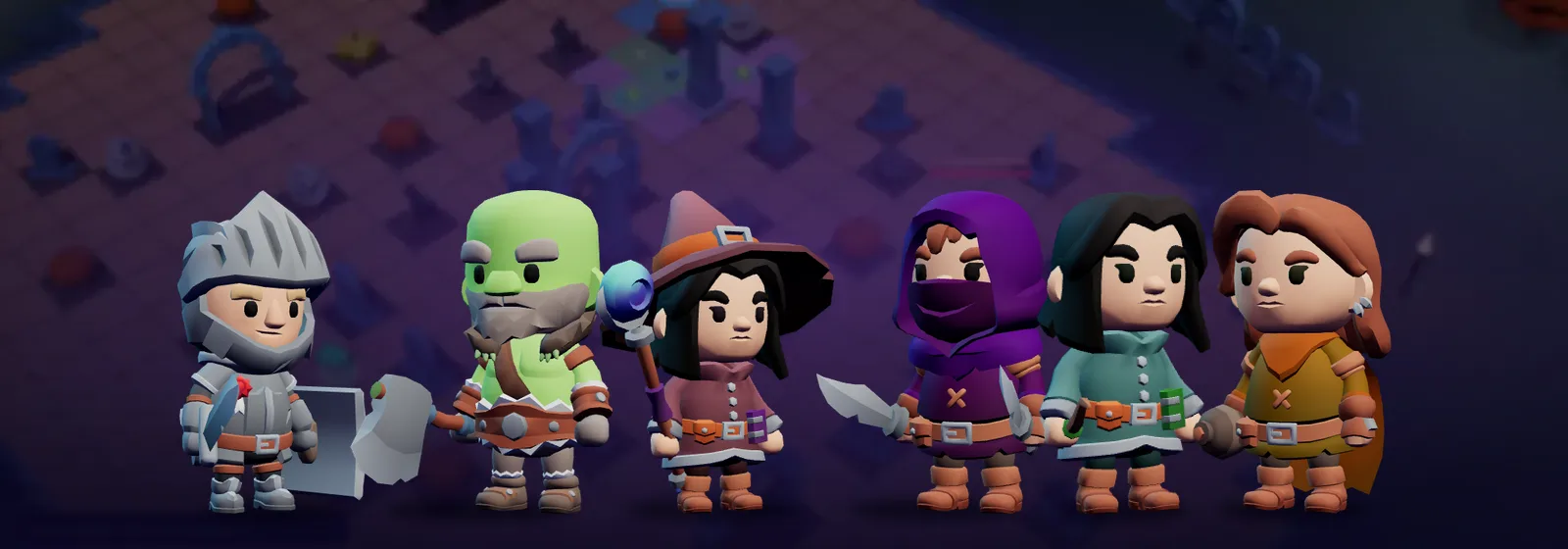
Six classes. One duel. Your strategy.
Pick a hero, take your position and beat another player — or an AI — turn by turn. Nothing to install: it plays right here.
Frequently asked questions
What is an Elo rating in simple terms?
It is a number that predicts how often you should beat a given opponent. After each game, you gain points if you did better than predicted and lose points if you did worse. Beating a stronger player pays a lot, beating a weaker one pays little.
What is the difference between Elo and Glicko?
Glicko adds a measure of how sure the system is about your rating. A new or inactive player has a wide uncertainty, so their rating moves fast. Glicko-2, used by Lichess, also tracks how consistent your results are.
Which online turn-based strategy games have ranked PvP?
Lichess and Chess.com for chess, Online-Go.com for Go, the Advance Wars By Web Global League for wargames, Board Game Arena with its seasonal Arena mode, Gods Unchained for cards, and Solwaris for 1v1 tactical duels with a rating per class.
Why does my rating change so much in my first games?
Most systems start new players with an uncertain rating and move it quickly until it settles near their real level. Solwaris does this with larger rating swings during the first ten matches of each class.